Have you ever paused in the middle of a hectic day, trying to catch your breath or reminding yourself to breathe deeply? The words breathe and breath are often confused, yet they play distinct roles in the English language.
Imagine a runner stopping after a long sprint. She needs a moment to regain her breath, while the act of taking in air is to breathe slowly. Both words are essential in describing life’s most natural process: respiration.
For English learners, understanding the difference between breathe and breath not only improves communication but also sharpens writing and expression.
Pronunciation:
- Breathe: /briːð/ (US & UK same)
- Breath: /brɛθ/ (US & UK same)
Difference Between Breathe and Breath
1. Part of Speech
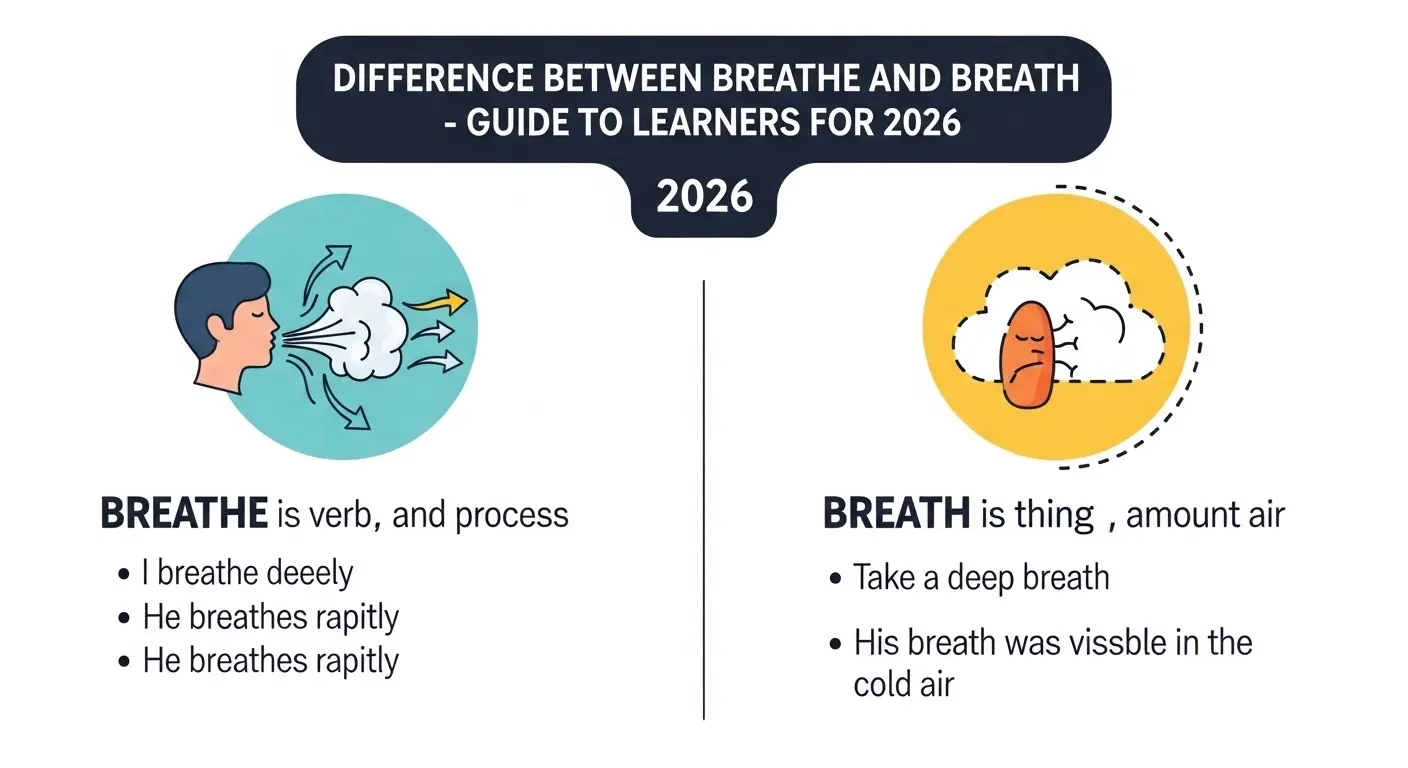
- Breathe is a verb. It describes the action of inhaling or exhaling air.
- Example 1: Please breathe deeply before speaking.
- Example 2: Doctors told him to breathe slowly during meditation.
- Breath is a noun. It refers to the air taken in or expelled.
- Example 1: She held her breath in surprise.
- Example 2: A cold breath escaped his mouth in the winter air.
2. Action vs. Object
- Breathe expresses the act of breathing.
- Example 1: He had to breathe after climbing the stairs.
- Example 2: Athletes learn to breathe correctly for stamina.
- Breath represents the air or puff itself.
- Example 1: A warm breath touched her cheek.
- Example 2: The dragon’s fiery breath scared the villagers.
3. Usage in Commands
- Breathe is used when instructing someone to perform an action.
- Example 1: Breathe in slowly.
- Example 2: Don’t forget to breathe during yoga.
- Breath cannot be used as a command because it is a noun.
- Example 1: Take a breath.
- Example 2: His breath was shallow after running.
4. Duration vs. Instant
- Breathe is continuous: it can happen repeatedly.
- Example 1: Try to breathe evenly for five minutes.
- Example 2: He breathes better after exercises.
- Breath is usually a single instance.
- Example 1: I took a deep breath.
- Example 2: A gust of breath blew through the room.
5. Emotional Expression
- Breathe can describe relaxation or calmness.
- Example 1: Breathe and let go of stress.
- Example 2: She breathes slowly to calm down.
- Breath often conveys emotion like fear, surprise, or exhaustion.
- Example 1: He held his breath in suspense.
- Example 2: The child’s breath came in gasps after the run.
6. Literary Use
- Breathe shows ongoing action.
- Example 1: “She breathes life into her art.”
- Example 2: Characters breathe in the fresh countryside air.
- Breath is used metaphorically or descriptively.
- Example 1: “Not a breath of wind stirred.”
- Example 2: “Every breath counts in the battle of survival.”
7. Spelling Confusion
- Breathe has an “-e” at the end because it’s a verb.
- Example 1: Don’t forget to breathe.
- Example 2: She breathes through her nose.
- Breath drops the “-e” because it is a noun.
- Example 1: He gasped for breath.
- Example 2: A frozen breath filled the air.
8. Synonyms and Replacement
- Breathe can be replaced with: inhale, exhale, respire.
- Example 1: Inhale slowly.
- Example 2: Learn to exhale fully.
- Breath can be replaced with: puff, wind, air.
- Example 1: A cold puff of breath.
- Example 2: Her breath smelled of peppermint.
9. Frequency in Speech
- Breathe is less frequent in casual speech.
- Example 1: Remember to breathe when stressed.
- Example 2: He breathes quietly while sleeping.
- Breath is more common in everyday descriptions.
- Example 1: Take a deep breath.
- Example 2: His breath fogged in the cold.
10. Idiomatic Expressions
- Breathe idioms:
- “Breathe easy” → feel relieved.
- Example: She could finally breathe easy after exams.
- “Breathe easy” → feel relieved.
- Breath idioms:
- “Hold your breath” → wait anxiously.
- Example: Don’t hold your breath waiting for him.
- “Hold your breath” → wait anxiously.
Nature and Behavior
- Breathe: Active, dynamic, represents motion and life.
- Breath: Static, descriptive, represents a unit or instance of air.
Why People Are Confused
Many confuse them because the difference is subtle: a noun vs. a verb. The ending “-e” in breathe is often overlooked, leading to misspellings and misused grammar.
Table of Difference and Similarity
| Feature | Breathe | Breath | Similarity |
| Part of Speech | Verb | Noun | Related to respiration |
| Action/Object | Action of taking air | Air itself | Both connected to air |
| Usage | Commands, actions | Descriptions | Commonly used in literature |
| Pronunciation | /briːð/ | /brɛθ/ | Both respiratory terms |
| Duration | Continuous | Instant | Express life/air |
| Emotion | Calmness, relaxation | Suspense, fear | Convey human state |
| Idioms | Breathe easy | Hold your breath | Express feelings metaphorically |
| Frequency | Less in casual speech | More in speech | Both everyday words |
| Literary Use | Active | Descriptive | Figurative writing |
| Spelling | Ends with -e | Drops -e | Easily confused |
Which Is Better in What Situation?
- Use breathe when describing actions or instructing someone. For instance, in health, meditation, or sports, it communicates movement and process.
- Use breath when referring to the air itself, expressing emotion, or in literary descriptions. It’s best for emphasizing a moment or creating imagery in writing.
Metaphors and Similes
- Breathe: “She breathes life into the poem.” (positive)
- Breath: “Not a breath of wind stirred.” (neutral)
Connotative Meaning
- Breathe: Positive, life-giving
- Breath: Neutral to slightly negative depending on context (e.g., cold breath)
Idioms/Proverbs
- Breathe easy: feel relief → After the results, she could finally breathe easy.
- Hold your breath: wait anxiously → Don’t hold your breath for the news.
Works in Literature
- “To Breathe or Not” – Poem, Jane Doe, 2018
- “A Quiet Breath” – Short story, John Smith, 2005
Movies
- Catch Your Breath 2016, UK
- Last Breath 1999, USA
FAQs:
- Can I use breathe as a noun?
- No, breathe is always a verb.
- Is breath always singular?
- It can be singular or plural (breaths).
- Why do people write “I need to breathe” as “breath”?
- Confusion between noun and verb forms.
- Are there idioms with breathe?
- Yes, e.g., “breathe easy,” meaning relief.
- Can breath indicate life?
- Yes, often used metaphorically in literature.
How Both Are Useful for Surroundings
- Breathe: Helps convey action, exercise, environmental health, mindfulness.
- Breath: Describes air quality, temperature, or emotional atmosphere in surroundings.
Final Words
Understanding the difference between breathe and breath is essential for clear communication. Both enrich English expression, literature, and daily speech. Correct usage avoids confusion and enhances writing.
Conclusion
The difference between breathe and breath hinges on one being a verb and the other a noun. While breathe represents action, breath captures an instance of air. Their proper usage enhances clarity in writing, expression of emotion, and understanding of human physiology.
English learners and writers benefit by mastering this distinction, making their speech and literature more precise. By exploring idioms, metaphors, and real-life examples, learners can confidently use both words, enriching both casual and professional communication.

I am an English content writer with more than 8 years of experience in writing about English word differences, grammar clarity, and everyday language usage. I am passionate about helping learners avoid common mistakes caused by similar-looking or confusing English words.
At diffruli.com, I write easy-to-understand guides that explain the difference between commonly confused words, spelling variations, and correct usage with real-life examples. My content is especially useful for students, writers, and non-native English speakers who want quick, accurate, and practical answers.