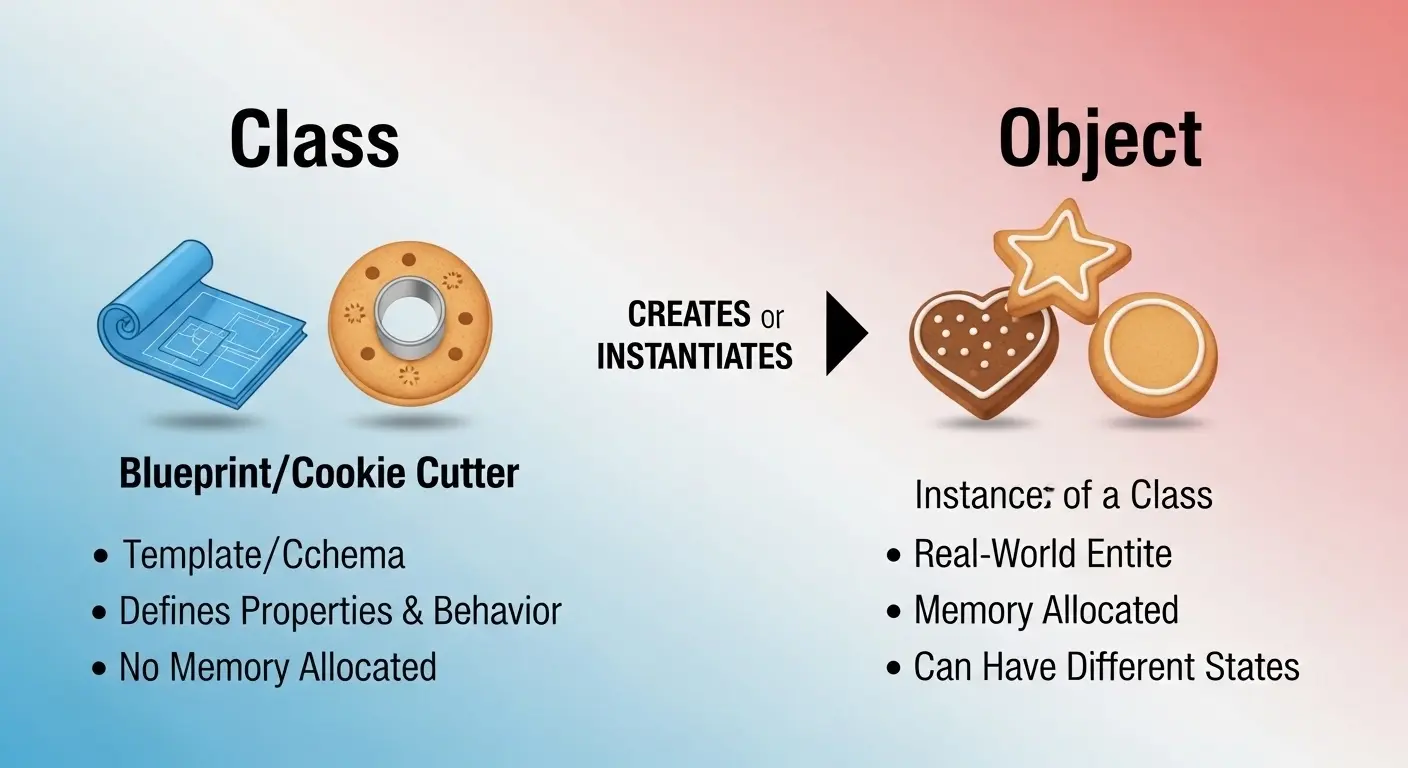
Imagine you are designing a house. Before building anything, you create a blueprint that defines how the house should look, how many rooms it will have, and what materials will be used. This blueprint is like a class.
Now, when you actually build houses using that blueprint, each house becomes an object. Understanding the difference between class and object is just like understanding the difference between a plan and its real-world execution.
In programming, the difference between class and object plays a vital role in structuring code efficiently. Developers often rely on this concept to organize data and behavior. Whether you’re a beginner or an expert, grasping the difference between class and object helps you write cleaner, reusable, and scalable programs.
Simply put, the difference between class and object defines how ideas are turned into working elements in software.
Key Difference Between Class and Object
A class is a blueprint or template, while an object is an instance of that class created in memory.
Why Is Their Difference Necessary to Know?
Understanding the distinction between class and object is crucial for both learners and professionals. It forms the foundation of object-oriented programming (OOP), which powers modern software systems used in society from mobile apps to banking systems.
For learners, it simplifies coding concepts and builds logical thinking. For experts, it enhances efficiency, scalability, and code reuse. In society, these concepts help developers create organized systems that drive technology, improve productivity, and support innovation across industries.
Pronunciation (US & UK)
- Class
- US: /klæs/
- UK: /klɑːs/
- US: /klæs/
- Object
- US: /ˈɑːb.dʒekt/ (noun)
- UK: /ˈɒb.dʒekt/
- US: /ˈɑːb.dʒekt/ (noun)
Difference Between Class and Object
1. Definition
- Class: A blueprint or template.
- Example 1: A “Car” class defines color, speed.
- Example 2: A “Student” class defines name, age.
- Example 1: A “Car” class defines color, speed.
- Object: A real instance of a class.
- Example 1: A red Toyota car.
- Example 2: A student named Ali.
- Example 1: A red Toyota car.
2. Existence
- Class: Logical entity.
- Example 1: Design of a phone.
- Example 2: Plan of a building.
- Example 1: Design of a phone.
- Object: Physical or real entity in memory.
- Example 1: Actual phone in hand.
- Example 2: Constructed building.
- Example 1: Actual phone in hand.
3. Memory Allocation
- Class: No memory allocated.
- Example 1: Recipe written on paper.
- Example 2: App design draft.
- Example 1: Recipe written on paper.
- Object: Memory allocated.
- Example 1: Cooked dish.
- Example 2: Installed app.
- Example 1: Cooked dish.
4. Creation
- Class: Declared once.
- Example 1: class Animal {}
- Example 2: class Book {}
- Example 1: class Animal {}
- Object: Created multiple times.
- Example 1: dog1, dog2
- Example 2: book1, book2
- Example 1: dog1, dog2
5. Purpose
- Class: Defines properties and methods.
- Example 1: Car has speed().
- Example 2: User has login().
- Example 1: Car has speed().
- Object: Uses those properties.
- Example 1: Car1.speed()
- Example 2: User1.login()
- Example 1: Car1.speed()
6. Relationship
- Class: Parent/template.
- Example 1: Fruit class.
- Example 2: Device class.
- Example 1: Fruit class.
- Object: Child/instance.
- Example 1: Apple.
- Example 2: Laptop.
- Example 1: Apple.
7. Reusability
- Class: Highly reusable.
- Example 1: One class used in many apps.
- Example 2: Template reused.
- Example 1: One class used in many apps.
- Object: Specific use.
- Example 1: One user instance.
- Example 2: One car instance.
- Example 1: One user instance.
8. Behavior
- Class: Defines behavior.
- Example 1: move(), eat().
- Example 2: play().
- Example 1: move(), eat().
- Object: Executes behavior.
- Example 1: dog.move()
- Example 2: child.play()
- Example 1: dog.move()
9. Representation
- Class: Abstract.
- Example 1: Idea of a bank.
- Example 2: Concept of a game.
- Example 1: Idea of a bank.
- Object: Concrete.
- Example 1: Bank branch.
- Example 2: Installed game.
- Example 1: Bank branch.
10. Dependency
- Class: Independent.
- Example 1: Can exist alone.
- Example 2: Defined without objects.
- Example 1: Can exist alone.
- Object: Depends on class.
- Example 1: Cannot exist without class.
- Example 2: Needs class structure.
- Example 1: Cannot exist without class.
Nature and Behaviour
- Class: Abstract, logical, and structural. It defines rules but does not perform actions itself.
- Object: Concrete, dynamic, and functional. It interacts and performs operations based on the class.
Why People Are Confused About Their Use?
People often confuse class and object because both are closely related and used together. Beginners may think they are interchangeable since objects cannot exist without classes. Additionally, similar terminology and lack of real-world analogies create misunderstanding.
Difference and Similarity Table
| Aspect | Class | Object | Similarity |
| Nature | Abstract | Concrete | Both part of OOP |
| Role | Blueprint | Instance | Work together |
| Memory | No memory | Uses memory | Related to program structure |
| Creation | Defined once | Created many times | Both created by programmer |
| Function | Defines behavior | Executes behavior | Both handle data & methods |
Which Is Better in What Situation?
A class is better when you need to define a general structure or model. It helps organize code and ensures consistency across multiple uses. For example, when designing a system for students or employees, classes provide a reusable framework that simplifies development.
An object is better when you need actual data and functionality in action. Objects allow you to work with real values and perform operations. For example, creating user accounts or processing transactions requires objects to represent real-world entities.
Metaphors and Similes
- Class is like a recipe, object is the dish.
- Class is like a blueprint, object is the building.
- Class is like a mold, object is the final shape.
Connotative Meanings
- Class: Neutral/Positive
- Example: “This system has a well-structured class design.”
- Example: “This system has a well-structured class design.”
- Object: Neutral
- Example: “Each object represents real data.”
- Example: “Each object represents real data.”
Idioms or Proverbs
- “A class apart”
- Example: His coding style is a class apart.
- Example: His coding style is a class apart.
- “Object of desire”
- Example: The new app became an object of desire.
- Example: The new app became an object of desire.
Works in Literature
- Object-Oriented Analysis and Design Technical, Grady Booch, 1994
- Clean Code Programming, Robert C. Martin, 2008
- Design Patterns Software Engineering, Erich Gamma, 1994
Movies Related to Concepts
- The Social Network (2010, USA)
- Steve Jobs (2015, USA)
- Ex Machina (2014, UK)
FAQs:
1. What is the main difference between class and object?
A class is a blueprint, while an object is its instance.
2. Can we create an object without a class?
No, objects are created from classes.
3. Why are classes important?
They help organize and reuse code efficiently.
4. How many objects can a class have?
A class can have multiple objects.
5. Are class and object used in all programming languages?
Mostly in object-oriented languages like Java, Python, and C++.
How Both Are Useful for Surroundings
Classes and objects help build software that supports daily life apps, websites, banking systems, and communication tools. They make systems organized, efficient, and easy to maintain.
Final Words for Both
Classes provide structure, while objects bring that structure to life. Together, they form the backbone of modern programming.
Conclusion:
The difference between class and object is fundamental in programming and essential for building efficient software systems. A class serves as a blueprint, while an object represents real-world implementation. Understanding their distinction allows developers to write clean, reusable, and scalable code.
If you are just starting or advancing in your coding journey, mastering this concept is key to success. Ultimately, the harmony between class and object drives innovation in the digital world and supports the technology we rely on every day.

I am an English content writer with more than 8 years of experience in writing about English word differences, grammar clarity, and everyday language usage. I am passionate about helping learners avoid common mistakes caused by similar-looking or confusing English words.
At diffruli.com, I write easy-to-understand guides that explain the difference between commonly confused words, spelling variations, and correct usage with real-life examples. My content is especially useful for students, writers, and non-native English speakers who want quick, accurate, and practical answers.