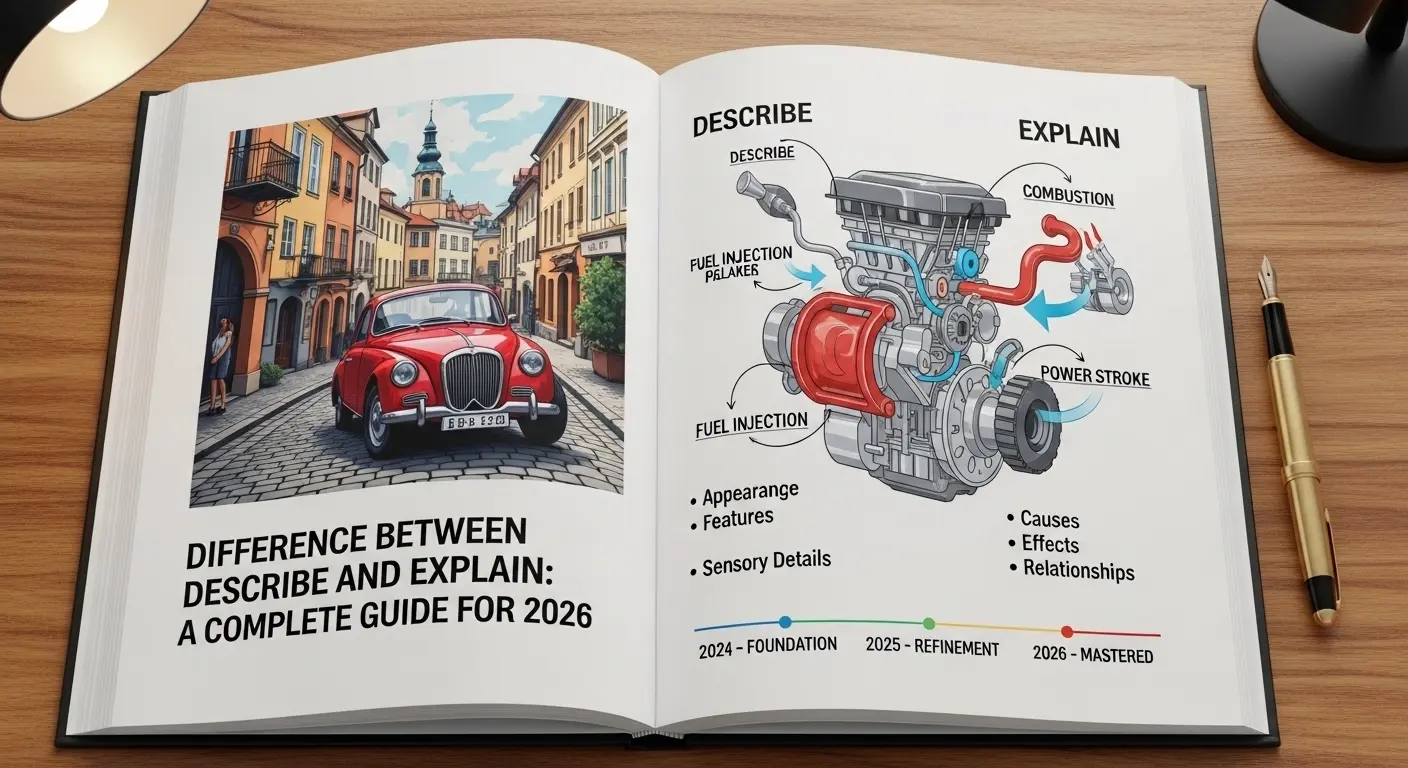
Imagine you are at a bustling farmer’s market. You see a vendor selling a peculiar fruit. If you describe it, you might say, “It’s round, green, with small bumps on the skin, and has a sweet aroma.” But if you explain it, you would go further:
This fruit is called a kiwano or horned melon. Its spiky skin protects it from pests, and its juice contains nutrients like vitamin C, which help boost immunity.” In everyday life, people often use describe and explain interchangeably, but they serve different purposes.
Knowing when to describe and when to explain is essential for effective communication, whether in writing, teaching, or even storytelling. Understanding the difference between describe and explain enhances clarity, precision, and depth in expressing ideas.
Pronunciation:
- Describe: US /dɪˈskraɪb/, UK /dɪˈskraɪb/
- Explain: US /ɪkˈspleɪn/, UK /ɪkˈspleɪn/
Let’s dive deeper to understand the precise difference between describe and explain.
Difference Between Describe and Explain
1. Purpose
- Describe: Focuses on depicting features, qualities, or appearance.
Example 1: “The car is red with leather seats.”
Example 2: “The sunset was golden, casting long shadows on the beach.” - Explain: Focuses on clarifying causes, reasons, or processes.
Example 1: “The car stopped because its engine overheated.”
Example 2: “The sunset appeared golden due to the scattering of light by the atmosphere.”
2. Depth of Information
- Describe: Gives surface-level information.
- Explain: Provides deeper understanding, context, and reasoning.
Examples:
- Describe: “The painting has blue and green tones.”
Explain: “The painter used blue and green to evoke calmness and harmony.”
- Describe: “The painting has blue and green tones.”
3. Focus on Observation vs Understanding
- Describe: Observational what you see, hear, touch, taste, or feel.
- Explain: Analytical why or how something occurs.
Examples:
- Describe: “The room is messy with scattered books.”
Explain: “The room is messy because the occupant didn’t organize after studying.”
- Describe: “The room is messy with scattered books.”
4. Structure
- Describe: Simple, descriptive sentences; often uses adjectives.
- Explain: Logical structure with cause and effect; often uses conjunctions like because, therefore, or due to.
Examples:
- Describe: “The river is wide and calm.”
Explain: “The river is wide because it collects water from several streams upstream.”
- Describe: “The river is wide and calm.”
5. Use in Writing
- Describe: Common in narratives, journals, and reports.
- Explain: Common in academic writing, tutorials, and analyses.
Examples:
- Describe: “The mountain peak was covered in snow.”
Explain: “The mountain peak is snow-covered because temperatures are below freezing year-round.”
- Describe: “The mountain peak was covered in snow.”
6. Nature of the Response
- Describe: Observes and recounts.
- Explain: Reasoning and interpreting.
Examples:
- Describe: “The cake is round and chocolate-flavored.”
Explain: “The cake tastes sweet because sugar caramelizes during baking.”
- Describe: “The cake is round and chocolate-flavored.”
7. Length of Expression
- Describe: Usually brief and focused.
- Explain: Often detailed with elaboration.
Examples:
- Describe: “The puppy is fluffy.”
Explain: “The puppy has fluffy fur to keep it warm in cold weather.”
- Describe: “The puppy is fluffy.”
8. Use of Evidence
- Describe: Doesn’t require evidence; based on observation.
- Explain: Often supported by facts, logic, or data.
Examples:
- Describe: “The leaves are green.”
Explain: “The leaves are green because chlorophyll absorbs sunlight for photosynthesis.”
- Describe: “The leaves are green.”
9. Mental Processing
- Describe: Requires perception and memory.
- Explain: Requires reasoning and critical thinking.
Examples:
- Describe: “The room smells of fresh paint.”
Explain: “The room smells of fresh paint because solvents are evaporating into the air.”
- Describe: “The room smells of fresh paint.”
10. Communication Goal
- Describe: Helps someone visualize or imagine.
- Explain: Helps someone understand or learn.
Examples:
- Describe: “The lake sparkled under the sunlight.”
Explain: “The lake sparkled because sunlight reflected off the rippling water surface.”
- Describe: “The lake sparkled under the sunlight.”
Nature and Behaviour
- Describe: Passive, observational, and neutral.
- Explain: Active, analytical, and often instructional.
Why People Are Confused
Many confuse the two because describing often leads into explaining. For instance, describing a storm (“It’s dark and windy”) can naturally evolve into an explanation (“This happens due to an approaching cold front”).
Comparison Table
| Feature | Describe | Explain | Similarity |
| Purpose | Depict features | Clarify reasons or processes | Both convey information |
| Depth | Surface-level | Detailed, contextual | Both can use clear language |
| Focus | Observation | Understanding | Both improve comprehension |
| Structure | Simple sentences | Logical, cause-effect | Both can be written or spoken |
| Use | Narrative, reports | Academic, tutorials | Both used in communication |
Which Is Better in What Situation?
- Describe: Best when you want your audience to visualize or imagine, such as in storytelling, travel writing, or descriptive essays.
- Explain: Best when your goal is to clarify concepts, teach, or solve problems, such as in science, education, or technical writing.
Use in Metaphors and Similes
- Describe: “Her smile was like sunshine, bright and warm.”
- Explain: “Life is like a river; just as it flows continuously, we must adapt to constant changes.”
Connotative Meaning
- Describe: Neutral conveys observation.
Example: “He described the city’s skyline without emotion.” - Explain: Positive conveys understanding or guidance.
Example: “She explained the process, making it easy for everyone.”
Idioms or Proverbs
- Describe: “A picture is worth a thousand words.” emphasizes vivid description.
- Explain: “Explain yourself” highlights accountability and reasoning.
Works in Literature
- Describe: The Description of England William Camden, 1586, Non-fiction
- Explain: An Explanation of Social Behavior John Dewey, 1922, Philosophy
Movies
- Describe: Describing Emily (2015, UK)
- Explain: Explain It to Me (2018, US)
FAQs:
- Can I use describe instead of explain? Sometimes, but it won’t clarify reasons.
- Is explaining always longer than describing? Often yes, because explanations need context.
- Do both use adjectives? Yes, but describing uses them more extensively.
- Is explaining only for academics? No, it is used in everyday life too.
- Why are they confused? Because description often leads into explanation naturally.
How Both Are Useful for Surroundings
Describing helps us notice details in our environment. Explaining helps us understand natural phenomena, societal behaviors, and cause-effect relationships, making us more informed citizens.
Final Words
Mastering the difference between describe and explain enhances your writing, speaking, and critical thinking skills. It allows for clear communication and better comprehension in daily life, education, and professional work.
Conclusion:
In essence, describing focuses on the what painting pictures with words for observation, while explaining focuses on the why and how providing reasoning and understanding. Confusing these two can lead to miscommunication, especially in education, business, or scientific writing.
By using both appropriately, we can convey information vividly while also helping our audience grasp deeper meanings. Recognizing the difference between describe and explain is key for writers, teachers, students, and anyone aiming to communicate effectively.

I am an English content writer with more than 8 years of experience in writing about English word differences, grammar clarity, and everyday language usage. I am passionate about helping learners avoid common mistakes caused by similar-looking or confusing English words.
At diffruli.com, I write easy-to-understand guides that explain the difference between commonly confused words, spelling variations, and correct usage with real-life examples. My content is especially useful for students, writers, and non-native English speakers who want quick, accurate, and practical answers.