A few years ago, a small startup hired two professionals to help build their online presence. One was a freelance graphic designer who worked with multiple clients from home. The other was a contract web developer hired for six months to complete a specific project. Both professionals were skilled, independent, and paid for their work, yet their roles were structured differently. This real-world scenario helps explain the difference between freelance and contract work.
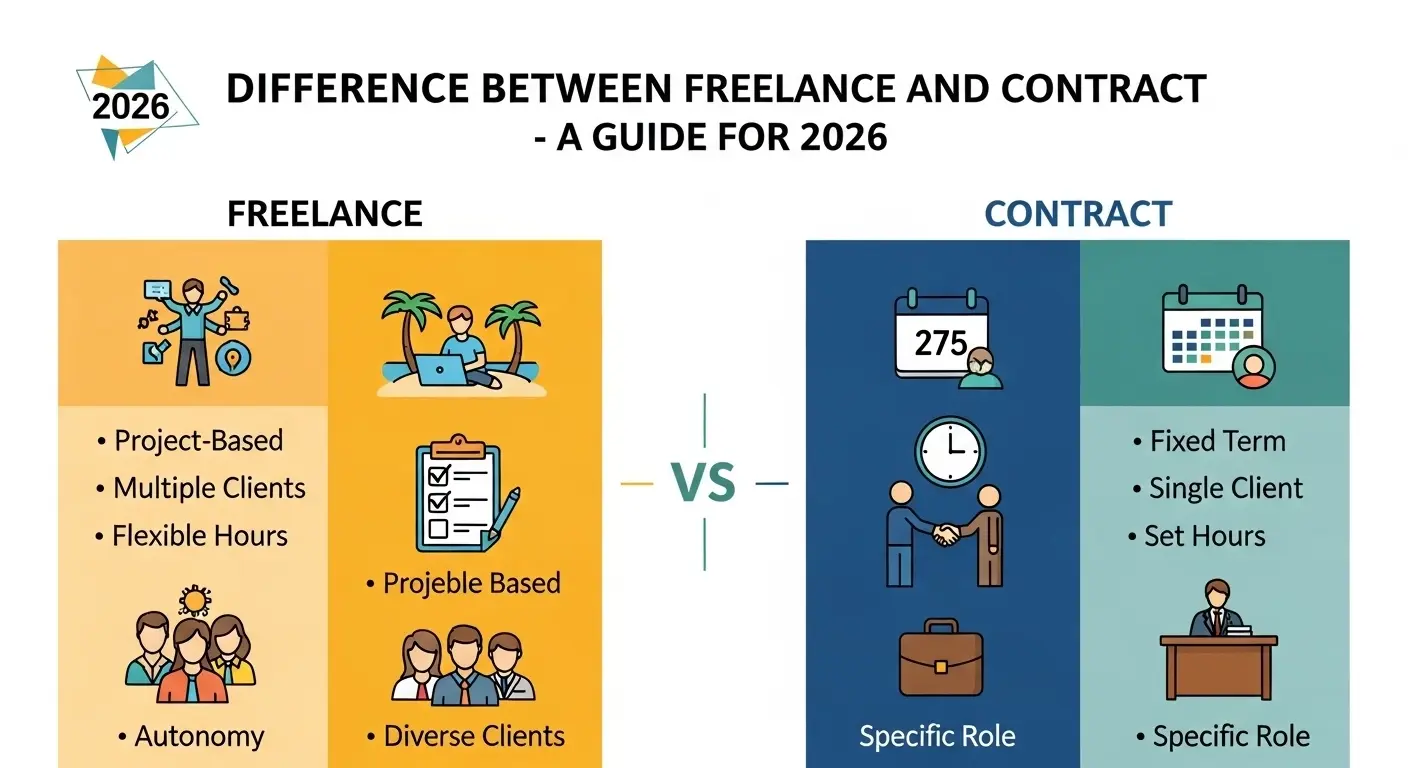
In simple terms, freelance refers to independent professionals who offer services to multiple clients without long-term commitment. A contract worker, however, is hired under a formal agreement to complete specific tasks for a defined period. Understanding the difference between freelance and contract roles is essential for businesses and workers alike.
Many people search for the difference between freelance and contract because the two often overlap in modern workplaces. Learning the difference between freelance and contract helps individuals choose the right career path and helps organizations hire effectively.
Before exploring the deeper comparison, let’s first look at how these terms are pronounced.
Pronunciation of Both Words
| Word | US Pronunciation | UK Pronunciation |
| Freelance | /ˈfriːlæns/ | /ˈfriːlɑːns/ |
| Contract (noun) | /ˈkɑːntrækt/ | /ˈkɒntrækt/ |
Both terms are widely used in business discussions and professional environments. Now, let’s explore the difference between freelance and contract in detail.
Difference Between Freelance and Contract
1. Employment Structure
Freelancers work independently without being tied to a single employer. Contract workers are hired by a company under a formal agreement for a specific period.
Examples
Freelance
• A writer working for five different blogs at the same time.
• A photographer taking assignments from various clients.
Contract
• A software developer hired for a 12-month company project.
• An accountant hired temporarily during tax season.
2. Duration of Work
Freelance work is usually ongoing and flexible. Contract work has a defined start and end date.
Examples
Freelance
• A designer working with clients whenever projects appear.
• A translator accepting tasks throughout the year.
Contract
• A marketing consultant hired for a three-month campaign.
• A construction engineer working until a project finishes.
3. Client Relationship
Freelancers maintain relationships with many clients simultaneously. Contract workers typically work with one company at a time.
Examples
Freelance
• A content writer serving multiple businesses.
• A social media manager handling several brands.
Contract
• An IT specialist hired by one company temporarily.
• A project manager working on a single corporate assignment.
4. Payment Structure
Freelancers are paid per project, task, or hour. Contract workers are usually paid according to the contract agreement.
Examples
Freelance
• A logo designer paid per design.
• A programmer charging hourly.
Contract
• A consultant receiving a fixed monthly payment.
• A researcher paid according to a signed agreement.
5. Work Flexibility
Freelancers have high flexibility in choosing projects and schedules. Contract workers must follow the terms of their contract.
Examples
Freelance
• A freelancer choosing when to work.
• A designer declining projects.
Contract
• A contractor following company deadlines.
• A consultant working specific hours.
6. Legal Agreement
Freelancers may or may not sign detailed contracts for each project. Contract workers always work under formal agreements.
Examples
Freelance
• A freelancer accepting a small job through email.
• A designer agreeing to work without long paperwork.
Contract
• A lawyer hired through an official contract.
• A project consultant signing detailed documents.
7. Job Security
Freelancers depend on a steady flow of clients. Contract workers enjoy temporary but stable work for the contract period.
Examples
Freelance
• A writer finding new clients regularly.
• A freelancer losing income if clients disappear.
Contract
• A six-month job guaranteed through agreement.
• A contractor knowing the project duration.
8. Work Environment
Freelancers usually work remotely. Contract workers often work at the hiring company.
Examples
Freelance
• A programmer working from home.
• A digital artist working online.
Contract
• An engineer working onsite for a company.
• A consultant attending office meetings.
9. Business Responsibility
Freelancers operate like small businesses. Contract workers act more like temporary employees.
Examples
Freelance
• Managing their own taxes and marketing.
• Finding clients independently.
Contract
• Following company policies.
• Reporting to supervisors.
10. Career Identity
Freelancing is often a long-term career model. Contract work is usually project-based employment.
Examples
Freelance
• A lifelong freelance journalist.
• A freelancer building personal brand.
Contract
• A professional taking short contracts between jobs.
• A consultant hired for major projects.
Nature and Behaviour of Both
Freelance
Freelance work is flexible, independent, and entrepreneurial. Freelancers behave like self-employed professionals who manage clients, pricing, and schedules.
Contract
Contract work is structured and temporary. Workers follow organizational rules and focus on completing specific assigned tasks.
Why People Are Confused About Their Use
People often confuse freelance and contract work because both involve temporary employment and independent professionals. In many industries, freelancers sign short contracts for projects, which makes the terms appear similar. Additionally, online job platforms frequently use the words interchangeably. However, the key distinction lies in independence versus structured agreement.
Difference and Similarity Table
| Aspect | Freelance | Contract | Similarity |
| Employment type | Independent | Temporary hired worker | Both non-permanent |
| Clients | Multiple clients | Usually one company | Both serve organizations |
| Duration | Flexible | Fixed | Both project-based |
| Agreement | Optional contracts | Formal contract required | Both involve professional work |
| Income style | Per project | Contract salary | Both paid for services |
Which Is Better in What Situation?
Freelance
Freelancing is better for individuals who value independence and creativity. It suits professionals who want control over their schedule and enjoy working with different clients. Designers, writers, and developers often prefer freelancing because it allows them to expand their portfolio and income sources.
Contract
Contract work is better for professionals who prefer stability for a certain period. It provides predictable income and structured responsibilities. Many engineers, consultants, and corporate specialists choose contract roles when working on large projects or during career transitions.
Use in Metaphors and Similes
Freelance metaphor
• “He moved through the industry like a freelance warrior, choosing his own battles.”
Contract metaphor
• “Her loyalty to the company was like a contract written in stone.”
Connotative Meanings
Freelance
Positive: independence, creativity
Negative: instability
Neutral: self-employment
Example
• “Freelance work gives her freedom to travel.”
Contract
Positive: professionalism, commitment
Negative: temporary limitation
Neutral: formal agreement
Example
• “His contract role helped him gain valuable experience.”
Idioms or Proverbs Related
“A deal is a deal.”
Example: Once the contractor signed the agreement, everyone said, “A deal is a deal.”
“Be your own boss.”
Example: Many freelancers love the chance to be their own boss.
Works in Literature
Freelance
• Freelance Writing Guide nonfiction, Robert Bly, 2005
Contract
• The Contract thriller novel, John Grisham style fiction tradition, 1990s themes
Movies Related to the Keywords
Freelance
• Freelance (2023, USA)
Contract
• The Contract (2006, USA/Germany)
FAQs:
1. What is the main difference between freelance and contract work?
Freelance work is independent and flexible, while contract work is based on a formal agreement with defined duration.
2. Can a freelancer also work on a contract?
Yes, freelancers often sign short contracts for specific projects.
3. Which pays more?
It depends on industry and experience, but freelancers sometimes earn more due to multiple clients.
4. Is contract work considered employment?
It is usually temporary employment for a specific project.
5. Which is more flexible?
Freelance work generally offers more flexibility.
How Both Are Useful for Society
Freelancers contribute creativity and innovation to industries by offering specialized skills. Contract workers help organizations complete large projects efficiently without long-term hiring commitments. Both play an essential role in the modern economy and digital workforce.
Final Words for Both
Freelance and contract work represent two evolving forms of modern employment. Each offers unique benefits and suits different professional goals. Understanding their differences helps workers and businesses make smarter decisions.
Conclusion:
Understanding the difference between freelance and contract work is essential in today’s dynamic job market. Freelancing emphasizes independence, flexibility, and entrepreneurial spirit, while contract work provides structured roles and temporary stability. Both systems support businesses and professionals by offering adaptable employment models.
While freelancers enjoy the freedom to work with multiple clients, contract workers benefit from clear agreements and predictable project timelines. Recognizing these differences allows individuals to choose the career path that matches their lifestyle and goals. Ultimately, both freelance and contract roles contribute significantly to the global economy and the evolving nature of modern work.

I am an English language writer and editor with over 10 years of experience in explaining confusing English words, grammar rules, and word usage differences. I specialize in making complex language topics simple, clear, and practical for everyday readers.
At diffruli.com, I am helping learners to understand common English word differences such as spelling variations, similar meanings, and correct usage in American and British English. My writing style is reader-friendly, example-driven, and designed to improve confidence in written and spoken English.