Imagine you walk into a small neighborhood shop. You buy a bottle of water and pay the cashier. The bottle you take home is a good, while the helpful assistance you receive from the shopkeeper is a service. This simple situation explains the difference between good and service in everyday life. Goods are physical items you can touch and own, whereas services are activities or help provided to satisfy a need.
Understanding the difference between good and service is important because both play a vital role in modern economies. Every day we purchase goods such as food, clothes, and electronics, while we also rely on services like transportation, education, healthcare, and banking. People often confuse these two concepts because they are closely connected in business and daily life.
Learning the difference between good and service helps students, business professionals, and consumers understand how markets work.
By exploring the difference between good and service, we can see how products and human efforts combine to create value in society.
Pronunciation (US & UK)
| Word | US Pronunciation | UK Pronunciation |
| Good | /ɡʊd/ | /ɡʊd/ |
| Service | /ˈsɝː.vɪs/ | /ˈsɜː.vɪs/ |
Before exploring deeper ideas, let us examine the difference between good and service in detail.
Difference Between the Keywords
1. Tangibility
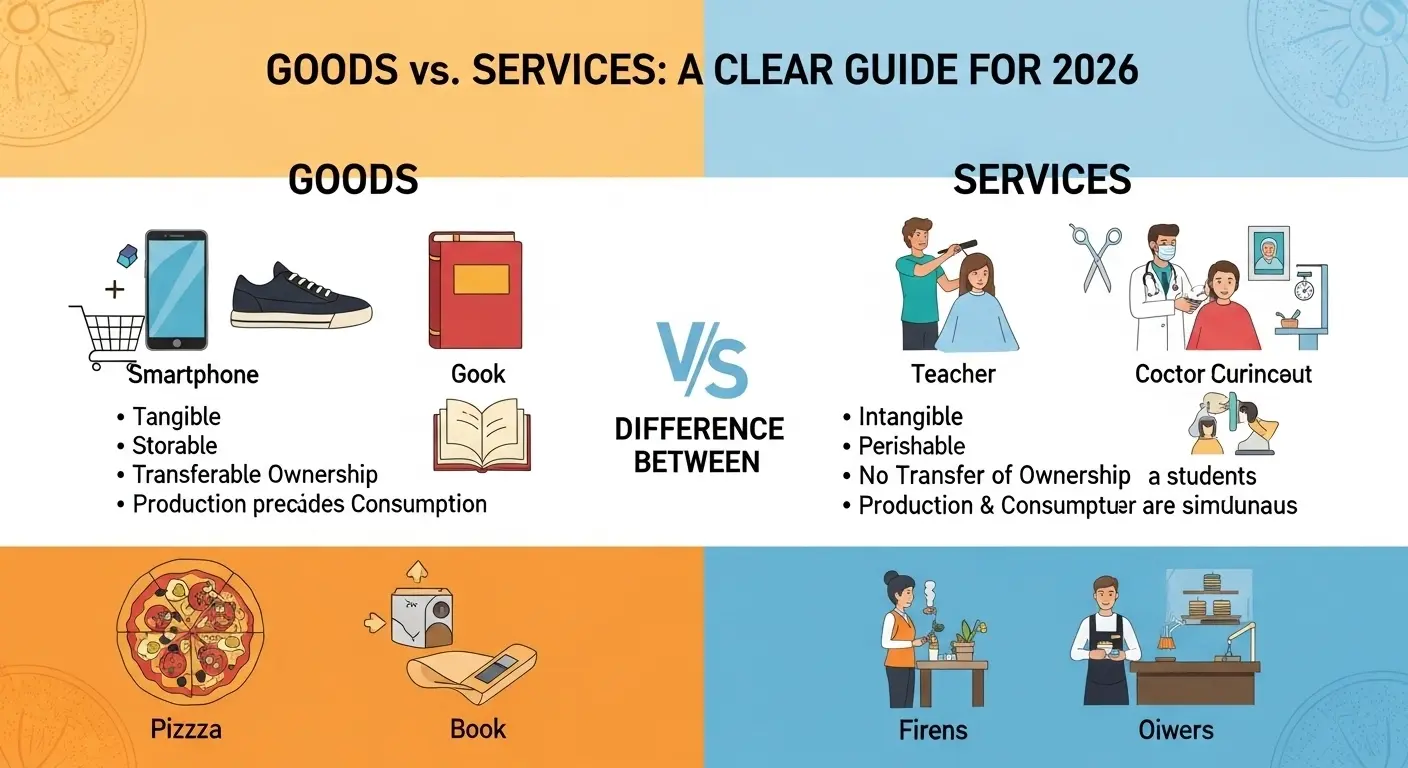
Goods: Goods are tangible, meaning they can be touched and physically owned.
Examples:
- A laptop bought from a store
- A loaf of bread from a bakery
Services: Services are intangible and cannot be physically touched.
Examples:
- A haircut at a salon
- A medical consultation with a doctor
2. Ownership
Goods: When you buy goods, ownership transfers to the buyer.
Examples:
- Buying a car from a dealer
- Purchasing a book from a bookstore
Services: Services do not involve ownership; they involve an activity performed for you.
Examples:
- Hiring a lawyer
- Using taxi transportation
3. Storage
Goods: Goods can be stored for future use.
Examples:
- Storing canned food in a pantry
- Keeping clothes in a wardrobe
Services: Services cannot be stored because they occur at the time of delivery.
Examples:
- A live music performance
- A classroom lecture
4. Production and Consumption
Goods: Goods are produced first and consumed later.
Examples:
- A factory produces shoes before customers buy them
- A bakery prepares cakes before selling them
Services: Services are produced and consumed at the same time.
Examples:
- A massage session
- A driving lesson
5. Quality Consistency
Goods: Goods often have consistent quality because they are manufactured.
Examples:
- Packaged snacks
- Smartphones from a production line
Services: Services may vary depending on the person providing them.
Examples:
- Customer support quality
- Teaching styles of different teachers
6. Return Possibility
Goods: Goods can often be returned or exchanged if defective.
Examples:
- Returning a faulty blender
- Exchanging a damaged shirt
Services: Services usually cannot be returned once performed.
Examples:
- A completed haircut
- A finished repair job
7. Physical Presence
Goods: Goods exist physically even without the consumer present.
Examples:
- Furniture in a showroom
- Groceries in a supermarket
Services: Services require interaction between provider and consumer.
Examples:
- A doctor examining a patient
- A teacher instructing students
8. Measurement
Goods: Goods are measured in units or quantities.
Examples:
- Two kilograms of rice
- Three bottles of juice
Services: Services are measured by time or performance.
Examples:
- One hour of tutoring
- Thirty minutes of therapy
9. Transferability
Goods: Goods can be transferred from one person to another.
Examples:
- Selling a used bicycle
- Giving a book as a gift
Services: Services cannot be transferred once delivered.
Examples:
- A personal training session
- A dental treatment
10. Production Location
Goods: Goods are often produced in factories or workshops.
Examples:
- Cars manufactured in an automobile plant
- Furniture made in a carpentry workshop
Services: Services are usually performed where the customer needs them.
Examples:
- Home cleaning services
- Taxi rides
Nature and Behaviour of Both
Goods: Goods have a physical form and can be owned, stored, transported, and resold. They usually come from manufacturing processes and maintain consistent quality.
Services: Services involve actions, assistance, or expertise provided by individuals or organizations. They are temporary, experience-based, and often depend on human interaction.
Why People Are Confused About Their Use?
People often confuse goods and services because modern businesses combine both. For example, when you buy a smartphone, the device is a good, but the warranty support and customer service are services. Restaurants also provide food (goods) along with hospitality and serving (services). This blending of physical products and human effort makes the difference between good and service less obvious.
Table Showing Difference and Similarity
| Aspect | Goods | Services | Similarity |
| Nature | Tangible | Intangible | Both satisfy needs |
| Ownership | Transferable | Not transferable | Both involve payment |
| Storage | Can be stored | Cannot be stored | Both used by consumers |
| Production | Produced before use | Produced during use | Both create economic value |
| Quality | Usually consistent | May vary | Both aim for customer satisfaction |
Which Is Better in What Situation?
Goods in Practical Situations
Goods are better when people need a physical product that can be owned or used repeatedly. For example, buying furniture, electronics, or clothing provides long-term value because these items can be stored and reused. Goods are also suitable for trade and transportation across regions.
Services in Experience-Based Situations
Services are better when expertise, skills, or assistance are required. Medical care, education, and transportation are examples where the value comes from human knowledge and effort. In such situations, the benefit lies in the experience or help rather than a physical object.
Metaphors and Similes
- “Knowledge is a service to humanity.”
- “A loyal friend is a good beyond price.”
- “His advice was a service like a guiding light.”
- “Her kindness was as good as gold.”
Connotative Meaning
Good
- Positive: “She did a good deed.”
- Neutral: “This is a good product.”
- Negative (rare context): “Too good to be true.”
Service
- Positive: “He served the community with dedication.”
- Neutral: “Customer service is available.”
- Negative: “The service was disappointing.”
Idioms or Proverbs
- “Do someone a good turn.”
Example: She did me a good turn by helping with my project. - “Good things come to those who wait.”
Example: After years of hard work, his business finally succeeded. - “At your service.”
Example: The hotel staff said, “We are always at your service.”
Works in Literature
Good
- Good Omens Fantasy novel, Neil Gaiman & Terry Pratchett, 1990
- The Good Earth Historical fiction, Pearl S. Buck, 1931
Service
- Service Model Science fiction novel, Adrian Tchaikovsky, 2024
- In His Service Christian fiction, Various authors, 20th century
Movies Related to the Keywords
Good
- The Good, the Bad and the Ugly 1966, Italy/Spain
- Good Will Hunting 1997, USA
Service
- Secret Service 1931, USA
- The Service 2014, Philippines
FAQs:
1. What is the basic difference between good and service?
Goods are physical products, while services are activities performed to satisfy a need.
2. Can a business offer both goods and services?
Yes, many businesses combine both, such as restaurants or car dealerships.
3. Why are services intangible?
Because they involve actions or experiences rather than physical objects.
4. Are goods always manufactured?
Most goods are produced through manufacturing, agriculture, or crafting.
5. Which contributes more to the modern economy?
Both are essential, but the service sector dominates many modern economies.
How Both Are Useful for Surroundings
Goods provide the physical items needed for survival and comfort, such as food, shelter, and technology. Services, on the other hand, improve quality of life through education, healthcare, maintenance, and communication. Together, they create balanced economic and social development.
Final Words for Both
Goods represent tangible value, while services represent human effort and expertise. Inspite of this Both complement each other and together shape modern economic systems.
Conclusion
The difference between good and service lies mainly in their nature goods are tangible products, while services are intangible activities. Despite this difference, both aim to satisfy human needs and improve daily life. Goods provide the objects we use and own, whereas services offer expertise, support, and experiences.
Understanding the difference between good and service is important for students, business professionals, and consumers because it helps explain how markets function. In today’s interconnected economy, goods and services often work together, creating value for individuals and societies alike. Moreover Recognizing their unique roles helps us appreciate how businesses operate and how economies grow.

I am an English content writer with more than 8 years of experience in writing about English word differences, grammar clarity, and everyday language usage. I am passionate about helping learners avoid common mistakes caused by similar-looking or confusing English words.
At diffruli.com, I write easy-to-understand guides that explain the difference between commonly confused words, spelling variations, and correct usage with real-life examples. My content is especially useful for students, writers, and non-native English speakers who want quick, accurate, and practical answers.