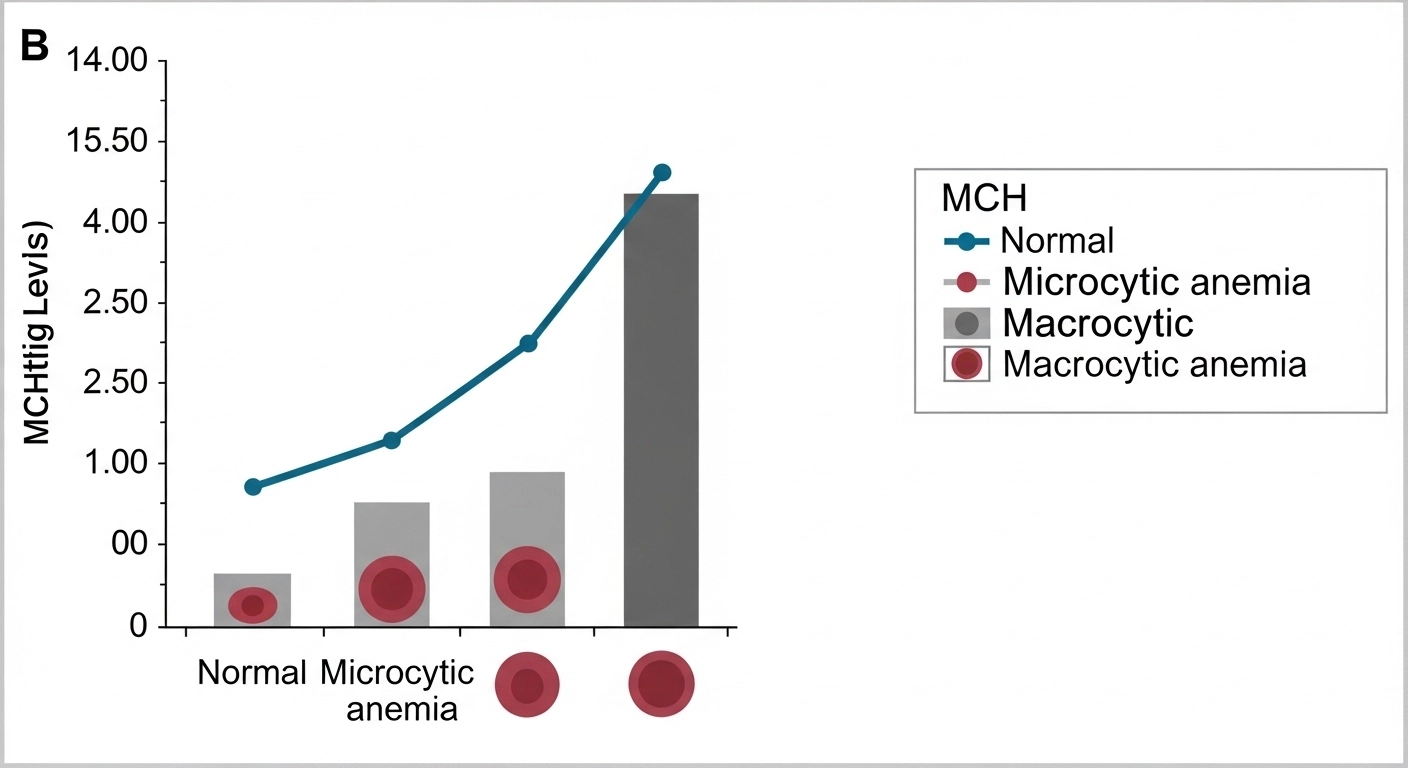
If you’ve ever had a routine blood test, chances are you’ve noticed terms like MCH and MCHC listed in your report. At first glance, these abbreviations might seem confusing. Imagine going to a doctor’s clinic, getting your blood tested, and seeing numbers next to MCH and MCHC. You might wonder: “Are they the same? Which one is more important?”
MCH (Mean Corpuscular Hemoglobin) refers to the average amount of hemoglobin in a single red blood cell, while MCHC (Mean Corpuscular Hemoglobin Concentration) indicates the concentration of hemoglobin in the red blood cells.
Both are vital indicators of blood health and help diagnose anemia or other blood disorders. Understanding the difference between MCH and MCHC can make patients, students, and even healthcare enthusiasts more informed about their well-being.
By exploring these two terms, we can appreciate how subtle differences in blood metrics carry significant medical insight.
Pronunciation:
- MCH – /ˌɛm.siːˈeɪtʃ/ (US & UK)
- MCHC – /ˌɛm.siːˌeɪtʃˈsiː/ (US & UK)
Knowing these terms opens the door to understanding more advanced medical discussions and lab reports. Let’s dive deeper into the key differences.
H2: Difference Between MCH and MCHC
1. Definition
- MCH: Measures the total hemoglobin per red blood cell.
- Example 1: A person with low MCH may have pale red blood cells.
- Example 2: High MCH can indicate vitamin B12 deficiency.
- Example 1: A person with low MCH may have pale red blood cells.
- MCHC: Measures the hemoglobin concentration within red blood cells.
- Example 1: Low MCHC indicates hypochromic anemia.
- Example 2: High MCHC may occur in hereditary spherocytosis.
- Example 1: Low MCHC indicates hypochromic anemia.
2. Unit of Measurement
- MCH: Picograms per cell (pg).
- Example 1: 28 pg per red blood cell.
- Example 2: A decrease to 25 pg signals possible anemia.
- Example 1: 28 pg per red blood cell.
- MCHC: Grams per deciliter (g/dL).
- Example 1: 34 g/dL is a normal reading.
- Example 2: 30 g/dL suggests low hemoglobin concentration.
- Example 1: 34 g/dL is a normal reading.
3. Nature of Measurement
- MCH: Absolute hemoglobin content per cell.
- MCHC: Relative hemoglobin concentration within the cell.
- Examples: MCH tells how much hemoglobin is present; MCHC tells how packed it is inside the cell.
4. Role in Diagnosing Anemia
- MCH: Helps identify macrocytic or microcytic anemia.
- MCHC: Helps identify hypochromic or hyperchromic anemia.
5. Sensitivity to Blood Disorders
- MCH: Less sensitive for iron deficiency detection.
- MCHC: More reliable for detecting iron-deficient anemia.
6. Calculation
- MCH: Hemoglobin ÷ RBC count.
- MCHC: Hemoglobin ÷ Hematocrit × 100.
7. Normal Range
- MCH: 27–33 pg.
- MCHC: 32–36 g/dL.
8. Behavior with Cell Size
- MCH: Increases with larger red cells (macrocytes).
- MCHC: Remains relatively stable; does not increase proportionally with cell size.
9. Nature in Blood Tests
- MCH: Can fluctuate depending on hydration and diet.
- MCHC: More constant; less influenced by external factors.
10. Clinical Implications
- MCH: Gives insights into hemoglobin content per cell.
- MCHC: Helps monitor hemoglobin quality and density.
Nature and Behavior
- MCH: Variable, reflects individual cell hemoglobin content.
- MCHC: Consistent, reflects concentration within cells.
Common Confusion
Many people confuse MCH and MCHC because both relate to hemoglobin in red blood cells, yet they measure different aspects: content vs concentration.
Comparison Table
| Feature | MCH (Mean Corpuscular Hemoglobin) | MCHC (Mean Corpuscular Hemoglobin Concentration) |
| Measures | Hemoglobin per RBC | Hemoglobin concentration in RBC |
| Unit | pg/cell | g/dL |
| Sensitive to | Cell size (macro/microcytes) | Hemoglobin quality/density |
| Normal Range | 27–33 pg | 32–36 g/dL |
| Clinical Use | Identifying anemias | Detecting hypochromic/hyperchromic anemia |
| Behavior | Fluctuates | Stable |
Which is Better in What Situation?
MCH: Useful when examining the absolute hemoglobin content in red blood cells, especially for macrocytic anemia. For instance, a doctor monitoring vitamin B12 deficiency will focus on MCH.
MCHC: Preferred for evaluating iron-deficiency anemia or spherocytosis because it indicates hemoglobin concentration. It is more reliable when density matters rather than total content.
Metaphors and Similes
- MCH: “Like the weight of sugar in each cube” shows total content.
- MCHC: “Like the sweetness in a glass of tea” shows concentration.
Connotation: Both are neutral but carry medical significance.
Related Idioms/Proverbs
- “Don’t judge a book by its cover” relates to MCHC (cells may look normal but have low hemoglobin).
- “Weight of the matter” relates to MCH (actual hemoglobin content).
MCH & MCHC in Literature & Movies
Literature:
- “The Hemoglobin Diaries” (Fiction, Dr. Emily Hart, 2018) blood analysis themes.
- “Red Cells” (Medical Drama, Dr. John Miles, 2020) focuses on lab diagnostics.
Movies:
- “Blood Test” (2019, UK) revolves around medical diagnostics.
- “The Cell Count” (2021, US) medical thriller on blood disorders.
FAQs:
- Are MCH and MCHC the same?
No, MCH measures hemoglobin per cell, MCHC measures its concentration. - Which is more important for anemia detection?
MCHC is generally more sensitive to iron deficiency anemia. - Can MCH fluctuate daily?
Yes, it can vary with diet or hydration. - Is a low MCHC dangerous?
It may indicate hypochromic anemia, needing medical evaluation. - Do MCH and MCHC always correlate?
Not always; high MCH does not guarantee high MCHC.
Environmental & Societal Relevance
Understanding MCH and MCHC helps public health officials track anemia prevalence, plan nutritional programs, and monitor populations’ blood health.
Final Words
MCH and MCHC, though often confused, offer complementary insights into blood health. Awareness of both ensures accurate diagnoses and better health monitoring.
Conclusion
MCH and MCHC are vital blood parameters that reveal hemoglobin’s content and concentration in red blood cells. While MCH focuses on the total hemoglobin per cell, MCHC emphasizes how densely packed hemoglobin is within the cell. Recognizing their differences helps healthcare providers detect and manage anemia and other blood disorders efficiently.
For students, patients, and medical enthusiasts, understanding these metrics improves comprehension of lab reports and overall blood health. By linking MCH to content and MCHC to concentration, one gains a clear, practical perspective. Both are essential, each with its distinct role, contributing to better medical care and informed health decisions.

I am an English content writer with more than 8 years of experience in writing about English word differences, grammar clarity, and everyday language usage. I am passionate about helping learners avoid common mistakes caused by similar-looking or confusing English words.
At diffruli.com, I write easy-to-understand guides that explain the difference between commonly confused words, spelling variations, and correct usage with real-life examples. My content is especially useful for students, writers, and non-native English speakers who want quick, accurate, and practical answers.