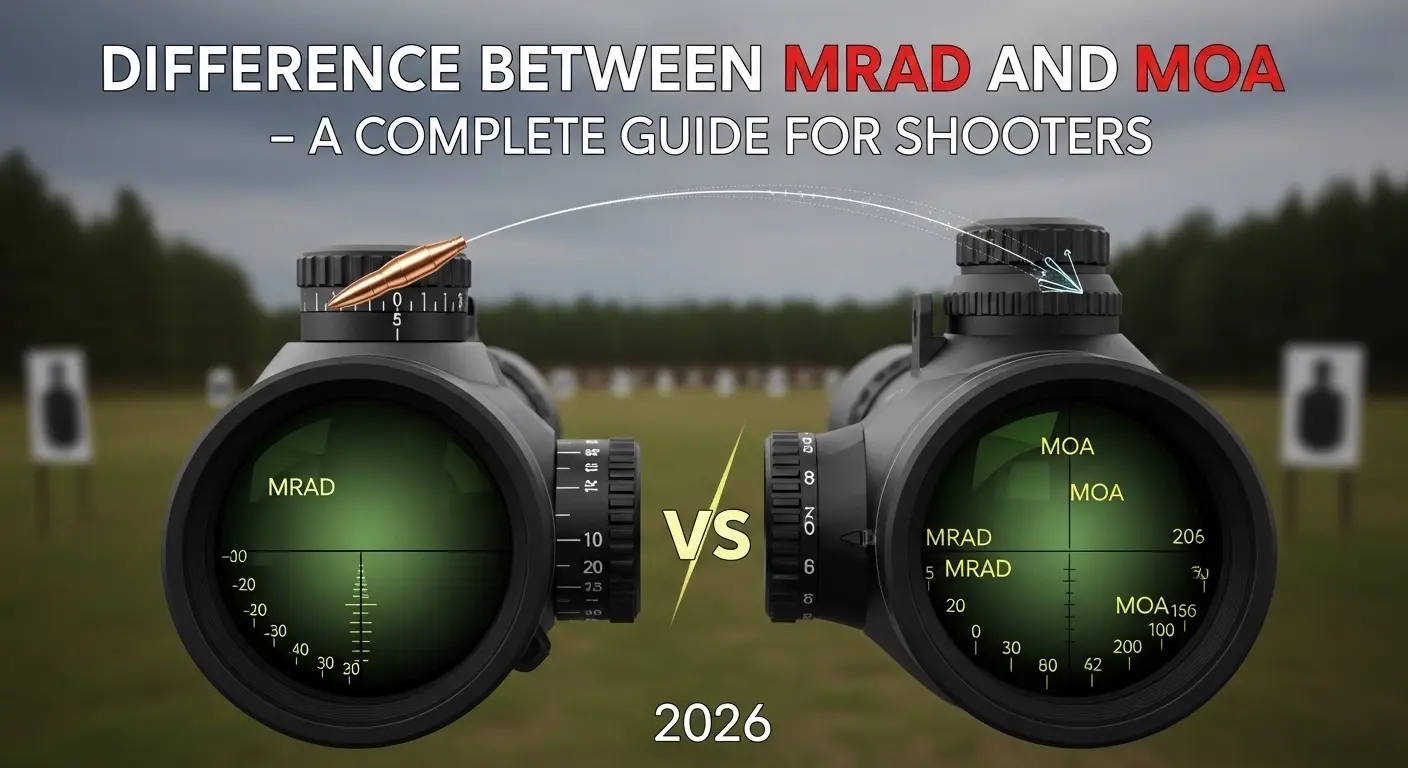
Precision shooting can be confusing for newcomers, especially when terms like MRAD and MOA are thrown around. Imagine a hunter preparing for a deer hunt at long range.
He adjusts his scope and hears two options: “Move it 0.5 MOA” or “Adjust 1 MRAD.” Without knowing the difference between MRAD and MOA, a single shot could miss the target entirely. MRAD and MOA are fundamental units used in ballistics and optics for accurate aiming.
If you’re in competitive shooting, military training, or long-range hunting, understanding the distinction between MRAD and MOA ensures consistent accuracy.
Many experts argue that mastering these two units can transform an average shooter into a precision marksman.
Pronunciation:
- MRAD: /ˈɛmˌræd/ (US & UK)
- MOA: /ˈmoʊ.ə/ (US), /ˈməʊ.ə/ (UK)
Knowing the difference between MRAD and MOA is essential for any serious marksman. Let’s explore the details to make these terms clear and practical.
Difference Between MRAD and MOA
1. Definition
- MRAD (Milliradian): Angular measurement where 1 MRAD equals 1/1000 of a radian.
Example 1: Adjusting a sniper rifle at 1000 meters, 1 MRAD = 1 meter.
Example 2: Shooting at 500 meters, 0.5 MRAD = 25 cm adjustment. - MOA (Minute of Angle): Angular measurement where 1 MOA = 1/60 of a degree.
Example 1: At 100 yards, 1 MOA ≈ 1.047 inches.
Example 2: At 200 yards, 2 MOA ≈ 2.094 inches.
2. Measurement Unit
- MRAD uses metric system, easy for meters and centimeters.
- MOA uses imperial system, convenient for inches and yards.
3. Scale
- MRAD: Smaller increments (0.1 MRAD) for precise adjustments.
- MOA: Slightly larger adjustments (0.25 or 0.5 MOA).
4. Calculation Simplicity
- MRAD: Directly converts to meters (metric-friendly).
- MOA: Requires additional math for inches/yards.
5. Usage Preference
- MRAD: Military and European shooters.
- MOA: US shooters, competitive sports.
6. Scope Reticle Markings
- MRAD: Often uses hash marks for decimal adjustments.
- MOA: Uses circles or dots with fractional MOA divisions.
7. Zeroing Procedure
- MRAD: Aligns easily with target at metric distances.
- MOA: Traditional zeroing at 100 yards standard.
8. Popularity in Rifles
- MRAD: Modern tactical rifles, sniper setups.
- MOA: Hunting rifles, older rifles in US.
9. Precision Level
- MRAD: Slightly finer adjustment possible due to decimal metric system.
- MOA: Adequate for most hunting/competition purposes.
10. International Standardization
- MRAD: Preferred by NATO and international forces.
- MOA: Primarily US-centric standard.
Nature and Behaviour
- MRAD: Precise, metric-friendly, technical, and tactical.
- MOA: Traditional, slightly less precise, more intuitive for US shooters.
Why People Are Confused
Many confuse MRAD and MOA because both measure angular adjustments in scopes and windage. Additionally, shooters may mix metric and imperial systems without realizing the subtle scale differences.
MRAD vs MOA Table of Comparison
| Feature | MRAD | MOA | Similarity |
| Unit Type | Metric (milliradian) | Imperial (minute of angle) | Both measure angular distance |
| Scale | 1/1000 radian | 1/60 degree | Used for scope adjustment |
| Usage | Military, tactical | Hunting, US shooting | Enhance precision |
| Popularity | Global | US | Long-range shooting |
| Adjustment | Decimal metric | Fractional inches/yards | Correct aim |
| Reticle Style | Hash marks | Dots/Circles | Scope markings |
| Zeroing | Metric targets | 100-yard standard | Align rifles |
| Precision | High | Moderate | Accurate aiming |
| Ease of Calculation | Metric simple | Requires conversion | Target compensation |
| Standardization | NATO | US | Worldwide shooting |
Which is Better in What Situation?
- MRAD: Ideal for long-range tactical shooting, military snipers, and metric-based competitions. Its decimal system makes rapid calculations easier at long distances.
- MOA: Better for hunting and US-based sports shooting, especially when distances are in yards and targets are smaller. Familiarity with inches makes it user-friendly.
MRAD and MOA in Metaphors and Similes
- MRAD: “As precise as an MRAD adjustment” → represents exactness.
- MOA: “Fine-tuned like a MOA click” → represents careful, measured action.
Connotative Meanings:
- MRAD: Positive (precision, technical mastery)
- MOA: Neutral/positive (practical, traditional)
Idioms/Proverbs Related
- “Measure twice, cut once” → aligns with MRAD precision.
- “Every inch counts” → reflects MOA adjustment philosophy.
Works in Literature
- The Longest Shot Military fiction, J. H. Roberts, 2011 (MRAD focus)
- Bullseye Sports thriller, L. Greene, 2005 (MOA reference)
Movies
- Sniper: Elite Marksman 2015, USA (MRAD used)
- Deadly Aim 2018, UK (MOA referenced)
FAQs:
- What does MRAD mean?
Milliradian, metric unit of angular measurement. - What does MOA mean?
Minute of Angle, imperial unit of angular measurement. - Can I convert MRAD to MOA?
Yes, 1 MRAD ≈ 3.438 MOA. - Which is better for hunting?
MOA is often easier for US hunters using yards/inches. - Do scopes support both?
Many modern scopes offer reticles with MRAD or MOA marks.
How Both Are Useful for Surroundings
MRAD and MOA help shooters adjust for wind, distance, and elevation, reducing missed shots and promoting safety. Proper use avoids accidents and environmental damage.
Final Words
Understanding MRAD and MOA ensures responsible and precise shooting. While they differ in scale, unit, and preference, both are invaluable in their respective domains.
Conclusion:
In long-range shooting, MRAD and MOA are the backbone of precision aiming. MRAD offers metric precision ideal for tactical and military operations, while MOA provides intuitive adjustment for hunters and US sports shooters.
Confusion arises from different units and scales, but mastering both ensures accuracy, safety, and efficiency. For enthusiasts, understanding these angular measurements transforms ordinary marksmanship into expert-level shooting, allowing shooters to adapt to any situation, distance, or environment.

I am an English language writer and editor with over 10 years of experience in explaining confusing English words, grammar rules, and word usage differences. I specialize in making complex language topics simple, clear, and practical for everyday readers.
At diffruli.com, I am helping learners to understand common English word differences such as spelling variations, similar meanings, and correct usage in American and British English. My writing style is reader-friendly, example-driven, and designed to improve confidence in written and spoken English.