In the fast-paced world of web development, understanding the difference between PATCH and PUT is crucial for building efficient applications. Imagine you’re updating a user profile on a social media platform.
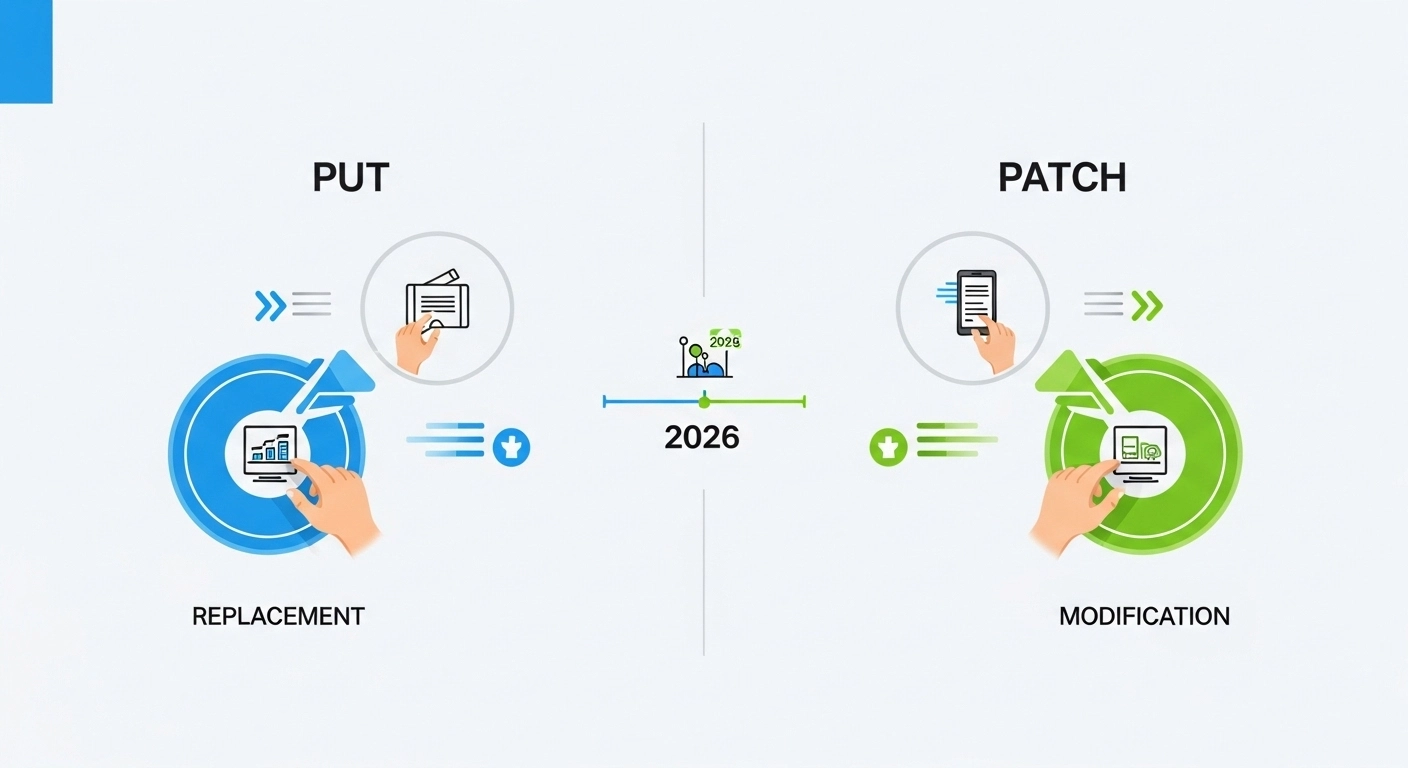
Using PUT, you might replace the entire profile, even if only the email changed. On the other hand, PATCH allows you to update just the email without touching other details.
For developers, knowing the difference between PATCH and PUT ensures that applications run smoothly and avoid unnecessary data overwrites.
Both PATCH and PUT are HTTP methods used to modify resources on a server, yet their scope and behavior are quite distinct. By grasping these differences, programmers can optimize APIs, reduce errors, and enhance user experience.
Pronunciation:
- PATCH: /pætʃ/ (US & UK)
- PUT: /pʊt/ (US & UK)
Understanding these distinctions is more than a technicality it’s a key to efficient coding. Let’s dive deeper.
Difference Between PATCH and PUT
Here are 08 key differences between PATCH and PUT, each with examples:
- Scope of Update
- PUT: Replaces the entire resource.
- Example 1: Updating a blog post with PUT will require sending the full content again.
- Example 2: Updating user info with PUT replaces all fields, even unchanged ones.
- Example 1: Updating a blog post with PUT will require sending the full content again.
- PATCH: Updates only specific fields.
- Example 1: Updating only the email in a user profile using PATCH.
- Example 2: Changing the title of a blog post using PATCH leaves the body intact.
- Example 1: Updating only the email in a user profile using PATCH.
- PUT: Replaces the entire resource.
- Idempotency
- PUT: Idempotent – repeating the request results in the same state.
- Example: PUTting the same user data multiple times won’t change the outcome.
- Example: PUTting the same user data multiple times won’t change the outcome.
- PATCH: Not necessarily idempotent; repeated requests may have different results.
- Example: PATCHing a counter field increases it each time.
- Example: PATCHing a counter field increases it each time.
- PUT: Idempotent – repeating the request results in the same state.
- Data Transmission Size
- PUT: Requires sending the full resource, which may increase data size.
- PATCH: Only sends changed fields, reducing payload size.
- PUT: Requires sending the full resource, which may increase data size.
- Use Cases
- PUT: Suitable for full updates of resources.
- PATCH: Ideal for partial updates or small modifications.
- PUT: Suitable for full updates of resources.
- Error Handling
- PUT: Easier to validate because the entire resource is sent.
- PATCH: Requires more careful validation to avoid partial update conflicts.
- PUT: Easier to validate because the entire resource is sent.
- Performance
- PUT: Slower for large resources due to full replacement.
- PATCH: Faster for minor changes because only part of the resource is updated.
- PUT: Slower for large resources due to full replacement.
- Server Behavior
- PUT: Server replaces the resource entirely.
- PATCH: Server modifies only the specified fields without altering others.
- PUT: Server replaces the resource entirely.
- Complexity of Request
- PUT: Simpler, just send the full object.
- PATCH: More complex; needs instructions on what to change.
- PUT: Simpler, just send the full object.
Nature and Behavior
- PUT: Full replacement, predictable, stable, safe for idempotent operations.
- PATCH: Partial modification, flexible, can vary with repeated requests, faster for minor edits.
Why people are confused:
Many developers mix up PATCH and PUT because both update resources. The confusion arises in partial vs. full updates and understanding idempotency.
Comparison Table: PATCH vs PUT
| Feature | PATCH | PUT | Similarity |
| Update Scope | Partial update | Full replacement | Both modify server resources |
| Idempotency | Not necessarily | Idempotent | Both are HTTP methods |
| Data Size | Small (only changes) | Large (entire resource) | Both send data to server |
| Performance | Faster for small changes | Slower for large updates | Both require proper validation |
| Use Case | Minor edits | Full resource updates | Both modify existing data |
Which is Better in What Situation?
PATCH is better when you want minimal changes to resources, like updating a single field or attribute. It reduces bandwidth and avoids overwriting untouched data.
PUT is better when replacing a complete resource, ensuring that the server always has a consistent, fully updated state. It’s simpler for larger resource updates.
Metaphors, Similes, and Connotations
- PATCH: Like patching a hole in a wall; precise, localized (positive).
- PUT: Like replacing the whole wall; comprehensive but heavier (neutral).
Idioms/Proverbs:
- PATCH: “Patch things up” repair a relationship or fix a minor issue.
- PUT: “Put all your eggs in one basket” total commitment (example of complete replacement).
Works in Literature & Movies
Literature:
- “Patchwork” novel, Anne Tyler, 1990
- “Putting Out Fires” short story, 2001
Movies:
- “Patch Adams” 1998, USA
- “Put the Needle on the Record” 2002, USA
FAQs
- Is PATCH faster than PUT?
Yes, PATCH sends only partial data. - Is PUT safer than PATCH?
PUT ensures full resource replacement; PATCH may risk partial inconsistency. - Can PATCH be idempotent?
Sometimes, but not guaranteed. - Which method is better for large data?
PUT is usually more reliable for full large updates. - Are both widely supported?
PUT is universally supported; PATCH may vary across frameworks.
Usefulness for Surroundings
PATCH and PUT allow applications to efficiently manage data, from social media profiles to online stores, ensuring minimal bandwidth usage and consistent information for users.
Final Words
Understanding the difference between PATCH and PUT is not just a technical detail but a cornerstone of good API design. Proper use ensures reliable, efficient, and scalable web applications.
Conclusion:
In web development, choosing between PATCH and PUT can make or break an API’s performance and reliability. PATCH is ideal for partial, efficient updates, while PUT guarantees complete, stable replacement.
Knowing when and how to use each method helps developers prevent errors, save bandwidth, and enhance user experience. By mastering PATCH and PUT, developers gain precise control over resources, which is vital in modern software ecosystems where every update counts.
Discover More Article:
Difference Between Wine and Beer- Taste and Culture Explained for 2026

I am an English language writer and editor with over 10 years of experience in explaining confusing English words, grammar rules, and word usage differences. I specialize in making complex language topics simple, clear, and practical for everyday readers.
At diffruli.com, I am helping learners to understand common English word differences such as spelling variations, similar meanings, and correct usage in American and British English. My writing style is reader-friendly, example-driven, and designed to improve confidence in written and spoken English.