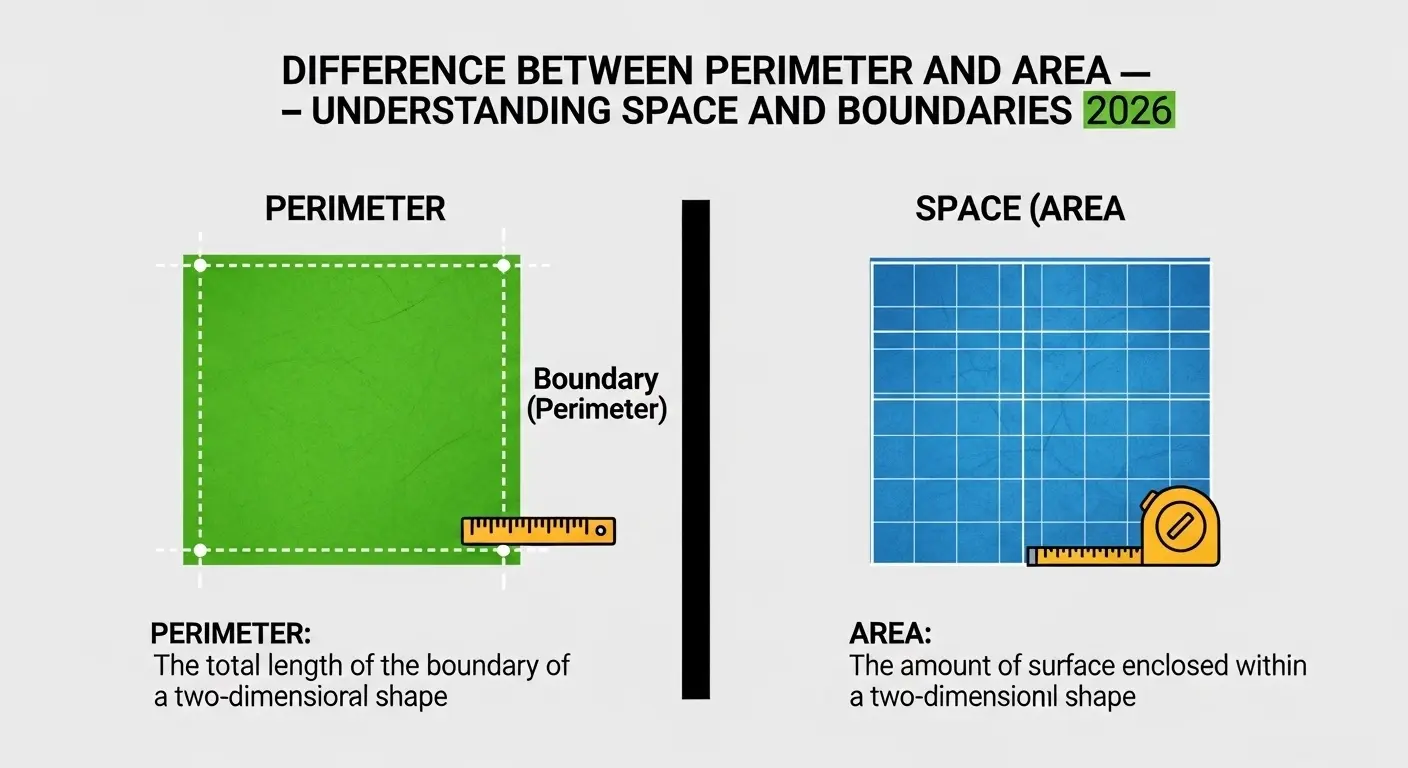
Imagine you’ve just bought a piece of land to build your dream home. The first thing you might ask is, “How much space do I have?” and “How long is the boundary I need to fence?” This is where understanding the difference between perimeter and area becomes essential. While both terms are commonly used in mathematics and real life, they serve very different purposes.
The difference between perimeter and area lies in what they measure one focuses on the boundary, while the other measures the space inside.
If you are a student solving geometry problems or an architect designing a structure, knowing the difference between perimeter and area helps you make accurate decisions.
Even in everyday tasks like gardening or flooring, the difference between perimeter and area plays a key role in planning and budgeting.
Key Difference Between Perimeter and Area
The main difference between perimeter and area is simple:
- Perimeter measures the total length of the boundary of a shape.
- Area measures the total space enclosed within that boundary.
Why Their Difference Matters in Society
Understanding the difference between perimeter and area is crucial for both learners and professionals:
- Students use it to solve geometry problems and build foundational math skills.
- Engineers and architects rely on it for designing buildings and structures.
- Farmers and landscapers use it for land measurement and fencing.
- Everyday life applications include painting walls, tiling floors, or installing fences.
Without knowing the distinction, people could miscalculate materials, waste money, or make inefficient designs.
Pronunciation (US & UK)
- Perimeter
- US: /pəˈrɪm.ə.t̬ɚ/
- UK: /pəˈrɪm.ɪ.tər/
- Area
- US: /ˈer.i.ə/
- UK: /ˈeə.ri.ə/
Difference Between the Keywords
1. Definition
- Perimeter: Total boundary length
- Example 1: A square fence around a garden
- Example 2: Measuring the edges of a football field
- Area: Space inside a shape
- Example 1: Size of a room
- Example 2: Surface of a park
2. Measurement Type
- Perimeter: Linear (meters, feet)
- Example 1: 20 meters of rope
- Example 2: 50 feet of boundary
- Area: Square units (m², ft²)
- Example 1: 200 m² land
- Example 2: 500 ft² room
3. Purpose
- Perimeter: Used for boundaries
- Example 1: Fencing land
- Example 2: Framing a picture
- Area: Used for coverage
- Example 1: Painting walls
- Example 2: Installing tiles
4. Formula Nature
- Perimeter: Sum of sides
- Area: Depends on shape (multiplication)
P=2(l+w)P = 2(l + w)P=2(l+w)
A=l×wA = l \times wA=l×w
5. Units
- Perimeter: cm, m, km
- Example 1: 30 cm wire
- Example 2: 2 km track
- Area: cm², m²
- Example 1: 100 cm² paper
- Example 2: 50 m² land
6. Dimension
- Perimeter: One-dimensional
- Area: Two-dimensional
7. Application
- Perimeter: Borders
- Area: Surfaces
8. Calculation Method
- Perimeter: Addition
- Area: Multiplication
9. Visual Concept
- Perimeter: Outline
- Area: Interior
10. Real-life Example
- Perimeter: Fence length
- Area: Land size
Nature and Behavior
- Perimeter: Focuses on edges and boundaries; changes when sides change.
- Area: Focuses on internal space; increases faster as dimensions grow.
Why People Are Confused
People often confuse them because:
- Both relate to shapes
- Both involve measurement
- Both are taught together in geometry
However, they measure entirely different aspects.
Table: Difference and Similarities
| Feature | Perimeter | Area | Similarity |
| Meaning | Boundary length | Space inside | Both measure shapes |
| Units | Linear | Square | Use standard units |
| Dimension | 1D | 2D | Mathematical concepts |
| Usage | Fencing | Flooring | Used in real life |
Which is Better in What Situation?
Perimeter is better when dealing with boundaries. For example, if you need to install a fence, knowing the perimeter ensures you buy the correct length of material. It helps in outlining spaces and securing areas.
Area is better when dealing with coverage. For example, if you are painting a wall or laying tiles, area helps you calculate how much material you need. It ensures efficiency and prevents waste.
Metaphors and Similes
- Perimeter: “He built a perimeter around his emotions like a fortress.”
- Area: “Her influence covered a vast area like sunlight spreading across the land.”
Connotative Meaning
- Perimeter: Neutral (sometimes protective)
- Example: “Set a perimeter for safety.”
- Area: Neutral to positive
- Example: “A large area of opportunity.”
Idioms and Proverbs
- “Stay within the lines” (related to boundaries/perimeter)
- “Expand your horizons” (related to area)
Examples:
- “He stayed within the lines and followed rules.”
- “She expanded her horizons and explored new areas.”
Works in Literature
- Flatland: A Romance of Many Dimensions (Novel, Edwin A. Abbott, 1884)
- The Dot and the Line (Children’s book, Norton Juster, 1963)
Movies Related to Geometry Concepts
- Donald in Mathmagic Land (1959, USA)
- Stand and Deliver (1988, USA)
FAQs:
1. What is the main difference between perimeter and area?
Perimeter measures boundary; area measures space inside.
2. Can two shapes have the same area but different perimeters?
Yes, shapes can share area but differ in boundary length.
3. Which is easier to calculate?
Perimeter is usually simpler as it involves addition.
4. Where is area used in real life?
In construction, farming, painting, and design.
5. Why do students confuse them?
Because both relate to shapes and measurements.
How Both Are Useful for Surroundings
Perimeter helps in defining and protecting spaces, while area helps in utilizing space efficiently. Together, they support planning, construction, and organization in daily life.
Final Words for Both
Perimeter defines limits; area defines possibilities. Both are essential for understanding shapes and spaces.
Conclusion:
In conclusion, understanding the difference between perimeter and area is fundamental not only in mathematics but also in everyday life. While perimeter helps define boundaries, area allows us to measure space and capacity. From building homes to managing land and solving academic problems, both concepts play a vital role.
By clearly distinguishing between the two, learners and professionals can avoid confusion and make accurate calculations. Ultimately, mastering the difference between perimeter and area equips you with practical skills that extend far beyond the classroom into real-world applications.

I am an English language writer and editor with over 10 years of experience in explaining confusing English words, grammar rules, and word usage differences. I specialize in making complex language topics simple, clear, and practical for everyday readers.
At diffruli.com, I am helping learners to understand common English word differences such as spelling variations, similar meanings, and correct usage in American and British English. My writing style is reader-friendly, example-driven, and designed to improve confidence in written and spoken English.