Imagine standing in a bustling fish market, watching a chef carefully choose between two vibrant fish salmon and steelhead. At first glance, they look almost identical, yet their flavors, textures, and uses can vary in surprising ways. This everyday scenario perfectly introduces the difference between salmon and steelhead, a topic that often confuses both home cooks and seafood enthusiasts.
Understanding the difference between salmon and steelhead is not just for chefs; it matters to anyone who enjoys healthy eating or sustainable seafood choices.
While both fish belong to the same family, their habitats and culinary profiles create subtle yet important distinctions. Exploring the difference between salmon and steelhead helps you make better dietary decisions and appreciate their unique qualities.
In fact, knowing the difference between both can elevate your cooking and nutrition knowledge.
Key Difference Between the Both
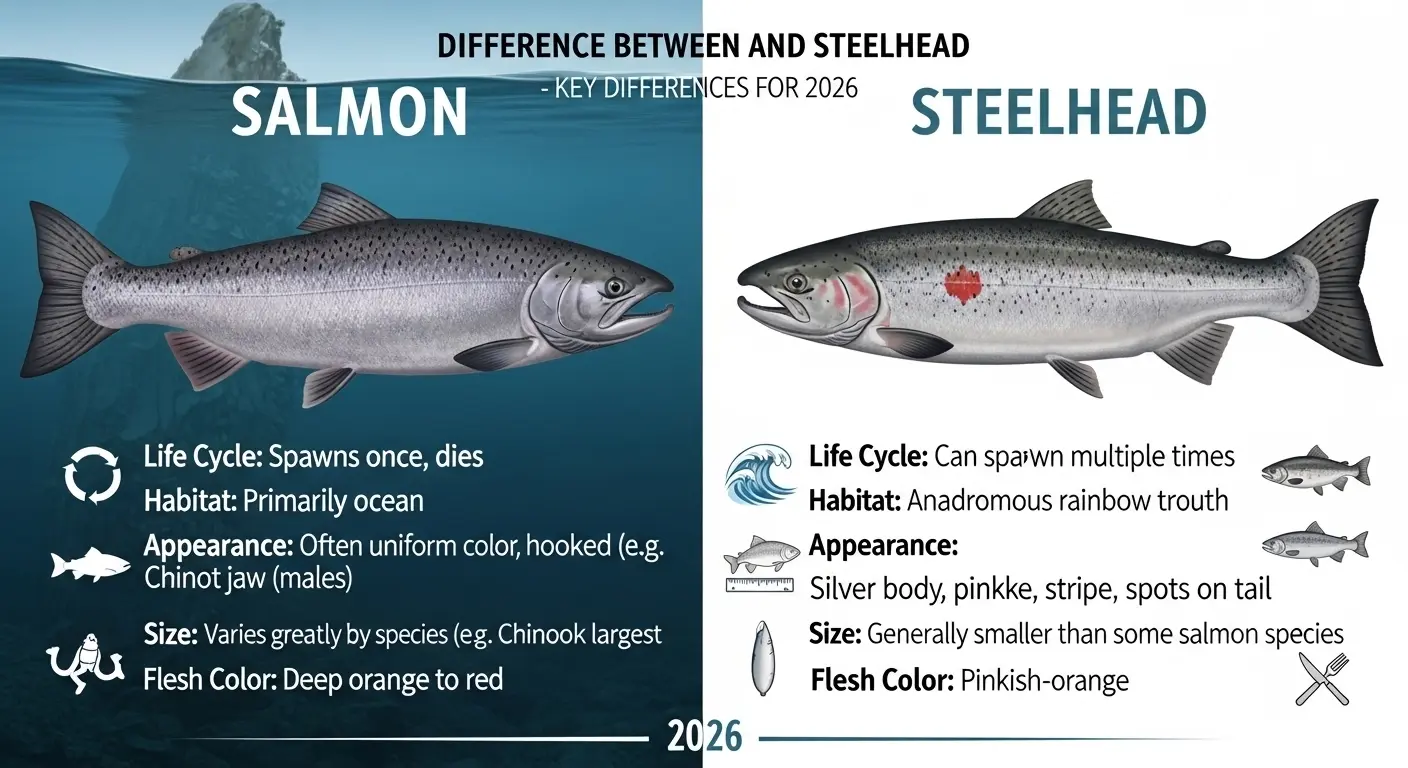
The main difference lies in their species, habitat, and flavor. Salmon is typically ocean-going, while steelhead can live in both freshwater and saltwater, resulting in distinct taste and texture.
Why Is Their Difference Important for Learners and Experts?
Understanding these differences is essential for nutritionists, chefs, environmentalists, and even students. It helps in:
- Choosing the right fish for specific recipes
- Understanding ecological sustainability
- Making informed dietary decisions
- Supporting responsible fishing practices
In society, seafood choices directly impact health trends and environmental conservation. Hence, knowing their differences is both practical and meaningful.
Pronunciation (US & UK)
- Salmon
- US: /ˈsæm.ən/
- UK: /ˈsæm.ən/
- Steelhead
- US: /ˈstiːl.hɛd/
- UK: /ˈstiːl.hɛd/
Difference Between Salmon and Steelhead
1. Species Type
Salmon refers to multiple species, while steelhead is a type of rainbow trout.
- Example 1: Atlantic salmon differs from Pacific salmon.
- Example 2: Steelhead is essentially migratory rainbow trout.
2. Habitat
Salmon mostly live in oceans; steelhead live in both freshwater and saltwater.
- Example 1: Salmon migrate to freshwater to spawn.
- Example 2: Steelhead can stay in rivers longer.
3. Flavor
Salmon has a rich, fatty flavor; steelhead is milder.
- Example 1: Salmon suits strong seasoning.
- Example 2: Steelhead works well with light herbs.
4. Texture
Salmon is firm and oily; steelhead is softer.
- Example 1: Salmon holds shape when grilled.
- Example 2: Steelhead flakes more easily.
5. Color
Salmon is deep orange/red; steelhead is lighter pink.
- Example 1: Sockeye salmon is bright red.
- Example 2: Steelhead appears pale pink.
6. Fat Content
Salmon contains more fat; steelhead is leaner.
- Example 1: Salmon is rich in omega-3.
- Example 2: Steelhead has fewer calories.
7. Price
Salmon is usually more expensive.
- Example 1: Wild salmon costs higher in markets.
- Example 2: Steelhead is budget-friendly.
8. Availability
Salmon is widely available; steelhead is less common.
- Example 1: Salmon is found globally.
- Example 2: Steelhead is more regional.
9. Cooking Methods
Salmon suits grilling; steelhead suits baking.
- Example 1: Salmon steaks for BBQ.
- Example 2: Steelhead fillets for oven cooking.
10. Nutritional Value
Both are healthy but differ slightly in nutrients.
- Example 1: Salmon is higher in fats.
- Example 2: Steelhead is lower in calories.
Nature and Behaviour
- Salmon: Known for long ocean migrations and strong homing instincts.
- Steelhead: More adaptable, capable of surviving in diverse water conditions.
Why People Are Confused
Their similar appearance, taste, and family classification cause confusion. Many markets even label them similarly, making it harder for buyers to distinguish.
Comparison Table
| Feature | Salmon | Steelhead |
| Species | Multiple species | Rainbow trout |
| Habitat | Mostly ocean | Fresh & saltwater |
| Flavor | Rich, fatty | Mild |
| Texture | Firm | Soft |
| Color | Deep orange/red | Light pink |
| Fat Content | High | Moderate |
| Price | Expensive | Affordable |
| Similarity | Both are healthy fish | Both rich in omega-3 |
Which Is Better in What Situation?
Salmon is better for dishes requiring bold flavor and richness, such as grilling or smoking. Its high fat content makes it ideal for gourmet meals and special occasions.
Steelhead is better for lighter meals and everyday cooking. Its mild taste suits simple recipes and healthier diets, making it perfect for quick, nutritious dishes.
Metaphors and Similes
- “Strong as salmon swimming upstream”
- “Smooth like steelhead in calm water”
Connotative Meaning
- Salmon: Positive (strength, endurance)
- Example: “She showed salmon-like determination.”
- Steelhead: Neutral to positive (adaptability)
- Example: “He adapted like a steelhead in changing waters.”
Idioms and Proverbs
- “Swim upstream like a salmon” (face challenges)
- Example: He chose to swim upstream like a salmon in his career.
Works in Literature
- The Salmon of Doubt Douglas Adams (Science fiction, 2002)
- Steelhead Country John Shewey (Nature writing, 2007)
Movies Related to Keywords
- Salmon Fishing in the Yemen (2011, UK)
- River of Steelhead (Documentary, USA)
FAQs:
1. Are salmon and steelhead the same?
No, they are different species though closely related.
2. Which tastes better?
It depends salmon is richer, steelhead is milder.
3. Is steelhead healthier than salmon?
Both are healthy; salmon has more omega-3.
4. Why are they often confused?
Because of their similar appearance and taste.
5. Which is more expensive?
Salmon is usually more costly.
How Both Are Useful for Surroundings
Both fish play a crucial role in aquatic ecosystems. They support biodiversity, provide nutrients to rivers, and contribute to sustainable fishing industries.
Final Words for Both
Salmon represents richness and strength, while steelhead symbolizes adaptability and balance. Both hold equal importance in culinary and ecological contexts.
Conclusion:
Understanding the difference between salmon and steelhead helps you make smarter choices in cooking, nutrition, and environmental awareness. While salmon stands out for its rich flavor and higher fat content, steelhead offers a lighter, more versatile alternative. Their similarities may confuse many, but their differences make each unique in its own way.
By learning these distinctions, you not only enhance your culinary skills but also contribute to better food decisions. Ultimately, both fish are valuable, delicious, and worthy additions to a healthy lifestyle.

I am an English language writer and editor with over 10 years of experience in explaining confusing English words, grammar rules, and word usage differences. I specialize in making complex language topics simple, clear, and practical for everyday readers.
At diffruli.com, I am helping learners to understand common English word differences such as spelling variations, similar meanings, and correct usage in American and British English. My writing style is reader-friendly, example-driven, and designed to improve confidence in written and spoken English.