Imagine a biology student in a lab trying to understand how life stores and transfers information. While studying cells, they come across two tiny but powerful molecules deoxyribose and ribose. At first glance, they seem almost identical, yet they play completely different roles in living organisms. Understanding the difference between deoxyribose and ribose is essential for grasping how DNA and RNA function.
The difference between deoxyribose and ribose lies in their structure, behavior, and biological purpose.
In fact, the difference between deoxyribose and ribose explains why DNA is stable while RNA is more flexible.
Exploring the difference between deoxyribose and ribose helps learners unlock the secrets of genetics and molecular biology.
Key Difference Between the Both
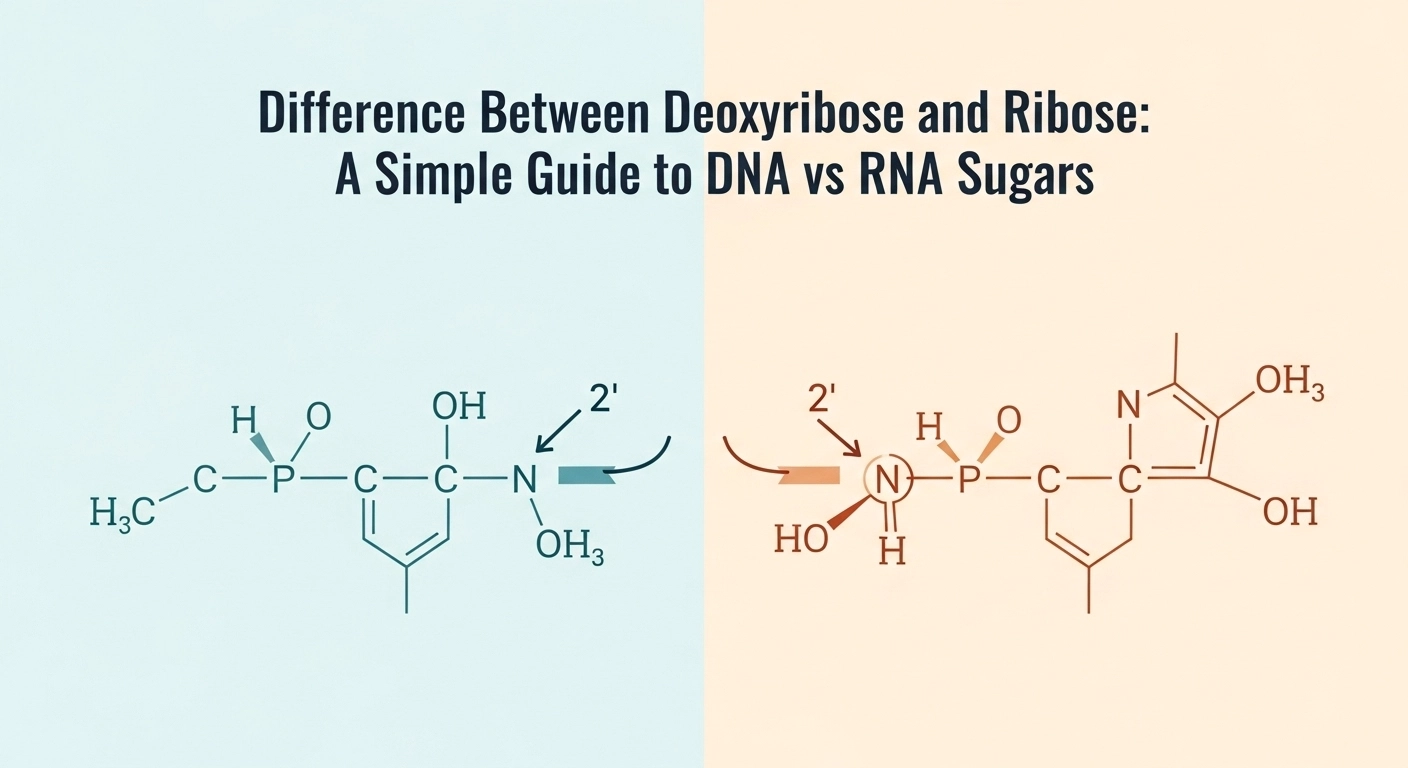
The primary difference lies in their chemical structure: deoxyribose lacks one oxygen atom compared to ribose. This small structural change leads to major differences in stability and function.
Why Is Their Difference Necessary to Know for Learners and Experts?
Understanding these sugars is crucial because they form the backbone of genetic material. Deoxyribose is part of DNA, which stores genetic information, while ribose is found in RNA, which helps in protein synthesis.
For students, this knowledge builds a strong foundation in biology. For researchers and experts, it aids in genetic engineering, medicine, and biotechnology. Their difference impacts everything from heredity to disease treatment, making it highly relevant in modern science and society.
Pronunciation (US & UK)
- Deoxyribose
- US: /diːˌɒksiˈraɪboʊs/
- UK: /diːˌɒksiˈraɪbəʊs/
- Ribose
- US: /ˈraɪboʊs/
- UK: /ˈraɪbəʊs/
Difference Between Deoxyribose and Ribose
1. Chemical Structure
- Deoxyribose has one less oxygen atom.
- Example 1: DNA contains deoxyribose sugar.
- Example 2: Its formula is C₅H₁₀O₄.
- Ribose has an extra oxygen atom.
- Example 1: RNA contains ribose sugar.
- Example 2: Its formula is C₅H₁₀O₅.
2. Presence in Nucleic Acids
- Deoxyribose is found in DNA.
- Example 1: Human genetic code uses DNA.
- Example 2: Chromosomes contain deoxyribose.
- Ribose is found in RNA.
- Example 1: mRNA carries genetic messages.
- Example 2: tRNA helps in protein synthesis.
3. Stability
- Deoxyribose is more stable.
- Example 1: DNA lasts for years in cells.
- Example 2: Fossil DNA can survive thousands of years.
- Ribose is less stable.
- Example 1: RNA breaks down quickly.
- Example 2: RNA molecules degrade in labs easily.
4. Function
- Deoxyribose stores genetic information.
- Example 1: DNA replication.
- Example 2: Genetic inheritance.
- Ribose helps transfer genetic information.
- Example 1: Protein synthesis.
- Example 2: Gene expression.
5. Molecular Role
- Deoxyribose forms double helix DNA.
- Example 1: Base pairing in DNA.
- Example 2: Stable genetic storage.
- Ribose forms single-stranded RNA.
- Example 1: Messenger RNA.
- Example 2: Ribosomal RNA.
6. Oxygen Atom at 2’ Carbon
- Deoxyribose lacks oxygen at 2’ carbon.
- Example 1: Makes DNA less reactive.
- Example 2: Prevents easy breakdown.
- Ribose has oxygen at 2’ carbon.
- Example 1: Makes RNA reactive.
- Example 2: Enables quick functions.
7. Biological Importance
- Deoxyribose ensures long-term storage.
- Example 1: Genetic continuity.
- Example 2: Evolutionary stability.
- Ribose ensures short-term activity.
- Example 1: Quick protein formation.
- Example 2: Temporary signaling.
8. Occurrence
- Deoxyribose is limited to DNA.
- Example 1: Cell nucleus.
- Example 2: Mitochondrial DNA.
- Ribose is found in many molecules.
- Example 1: ATP energy molecule.
- Example 2: NAD coenzyme.
9. Reactivity
- Deoxyribose is less reactive.
- Example 1: Stable bonds.
- Example 2: Resistant to hydrolysis.
- Ribose is more reactive.
- Example 1: Easily breaks bonds.
- Example 2: Participates in metabolism.
10. Role in Evolution
- Deoxyribose supports long-term evolution.
- Example 1: Genetic mutations.
- Example 2: Species survival.
- Ribose supports immediate adaptation.
- Example 1: Protein synthesis changes.
- Example 2: Cellular responses.
Nature and Behaviour
- Deoxyribose: Stable, less reactive, supports long-term genetic storage.
- Ribose: Reactive, flexible, supports quick cellular processes.
Why People Are Confused About Their Use
People often confuse them because their names and structures are very similar. Both are sugars involved in genetic material, and their difference is just one oxygen atom, making it hard for beginners to distinguish.
Table: Difference and Similarity
| Feature | Deoxyribose | Ribose | Similarity |
| Formula | C₅H₁₀O₄ | C₅H₁₀O₅ | Both are sugars |
| Found in | DNA | RNA | Both in nucleic acids |
| Stability | High | Low | Both essential |
| Oxygen | Less | More | Same base structure |
| Function | Storage | Transfer | Genetic roles |
Which Is Better in What Situation?
Deoxyribose is better when stability is required. It forms DNA, which stores genetic information safely over long periods. This makes it ideal for inheritance and maintaining life’s blueprint. Without deoxyribose, organisms would struggle to preserve their genetic identity.
Ribose is better for quick actions inside cells. It forms RNA and energy molecules like ATP, making it essential for immediate processes like protein synthesis. Its flexibility allows cells to respond rapidly to changes.
Metaphors and Similes
- Deoxyribose is like a vault protecting valuable information.
- Ribose is like a messenger delivering important instructions quickly.
Connotative Meanings
- Deoxyribose: Positive (stability, reliability)
- Example: “Her plans were as stable as deoxyribose.”
- Ribose: Neutral/Positive (activity, flexibility)
- Example: “He adapted like ribose in a changing environment.”
Idioms or Proverbs
(No direct idioms exist, but creative usage can be applied)
- “Strong as DNA backbone” (inspired by deoxyribose)
- “Fast as RNA response” (inspired by ribose)
Works in Literature
- DNA-related works:
- The Double Helix Memoir, James Watson, 1968
- RNA-related works:
- The RNA World Science, Raymond F. Gesteland, 1993
Movies Related to the Keywords
- Gattaca (1997, USA) DNA and genetics
- Jurassic Park (1993, USA) DNA science
FAQs
1. What is the main difference between deoxyribose and ribose?
Deoxyribose lacks one oxygen atom, while ribose has it.
2. Where is deoxyribose found?
It is found in DNA.
3. Why is ribose important?
It helps in RNA formation and energy transfer.
4. Which is more stable?
Deoxyribose is more stable.
5. Why do they look similar?
They have nearly identical structures with a small difference.
How Both Are Useful for Surroundings
Both sugars are essential for life. Deoxyribose ensures genetic stability, while ribose supports energy production and protein synthesis. Together, they maintain life processes and biological balance.
Final Words for Both
Deoxyribose and ribose may differ slightly in structure, but their roles are equally vital. One preserves life’s blueprint, while the other keeps life active and functioning.
Conclusion
The difference between deoxyribose and ribose may seem small, but it has a huge impact on biology. Deoxyribose provides stability for DNA, ensuring long-term storage of genetic information, while ribose allows RNA to perform dynamic cellular tasks.
Understanding this distinction helps learners grasp fundamental biological processes and supports advancements in science and medicine. Together, these sugars highlight how even the smallest molecular changes can shape the complexity of life.

I am an English content writer with more than 8 years of experience in writing about English word differences, grammar clarity, and everyday language usage. I am passionate about helping learners avoid common mistakes caused by similar-looking or confusing English words.
At diffruli.com, I write easy-to-understand guides that explain the difference between commonly confused words, spelling variations, and correct usage with real-life examples. My content is especially useful for students, writers, and non-native English speakers who want quick, accurate, and practical answers.